By the LeeSea Terms
When a vessel in going free has fallen off so much that the wind has been brought around the stern and taken her a-back. (See Bring by the Lee.)
Page 72 of Patterson’s Illustrated Nautical Encyclopedia · 24 entries
When a vessel in going free has fallen off so much that the wind has been brought around the stern and taken her a-back. (See Bring by the Lee.)
To let go altogether instead of slacking away gradually.
A vessel is said to be by the stern when she draws more water aft than she should do to be in her proper trim with relation to her draught forward.
Same as Full and By.
That part of a vessel in which the officers live. The captain's cabin is a separate room.
A rope or chain secured to the anchor.
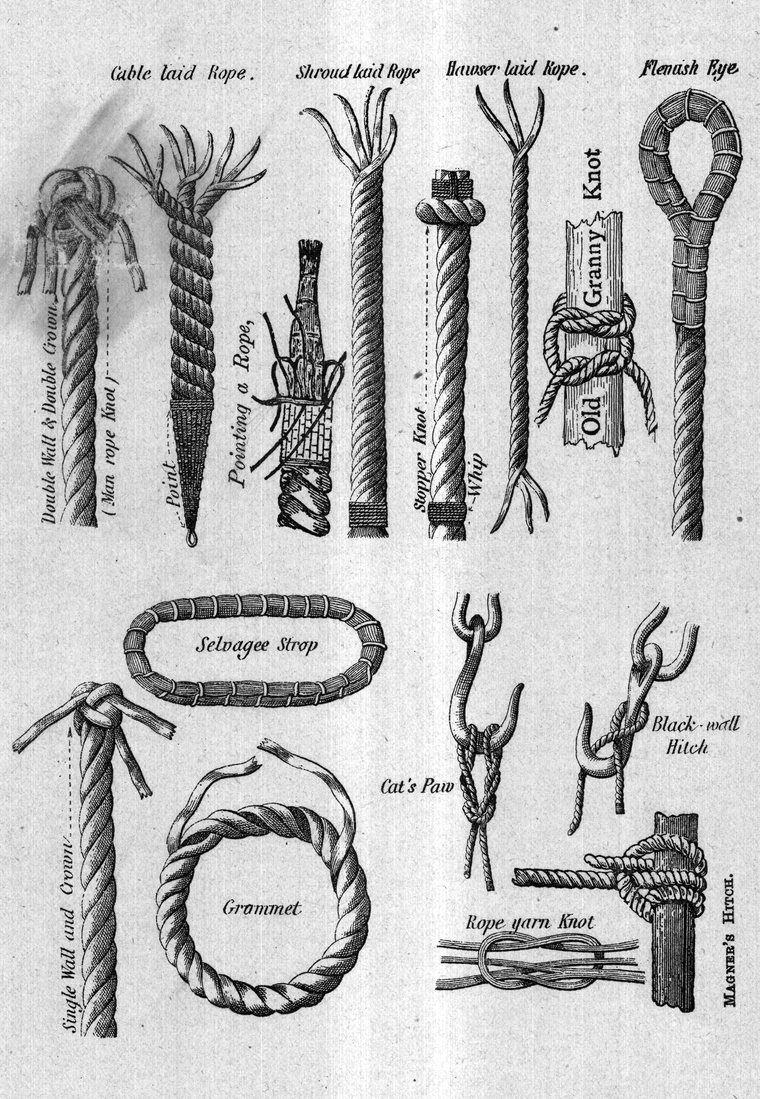
A nine-strand left-handed rope, laid up against the sun.
The place either in the hold or between decks in which the cable is stowed.
About one-tenth of a mile--100 fathoms of 6 feet each.
Also called galley. A house on deck where the cooking is done. (See Kitchen.)
A hole dug in the ground in which articles are placed for safe keeping, then the hole is covered.
A Levantine vessel. Also a skiff peculiar to Constantinople, used altogether for boat traffic. It is a narrow, crank boat having weights on the looms of the oars to counterbalance the weight of the outboard part.
A pyramid of stones erected to serve as a landmark.
A flat-bottom passenger boat used on the Loire.
(See Caulk.)
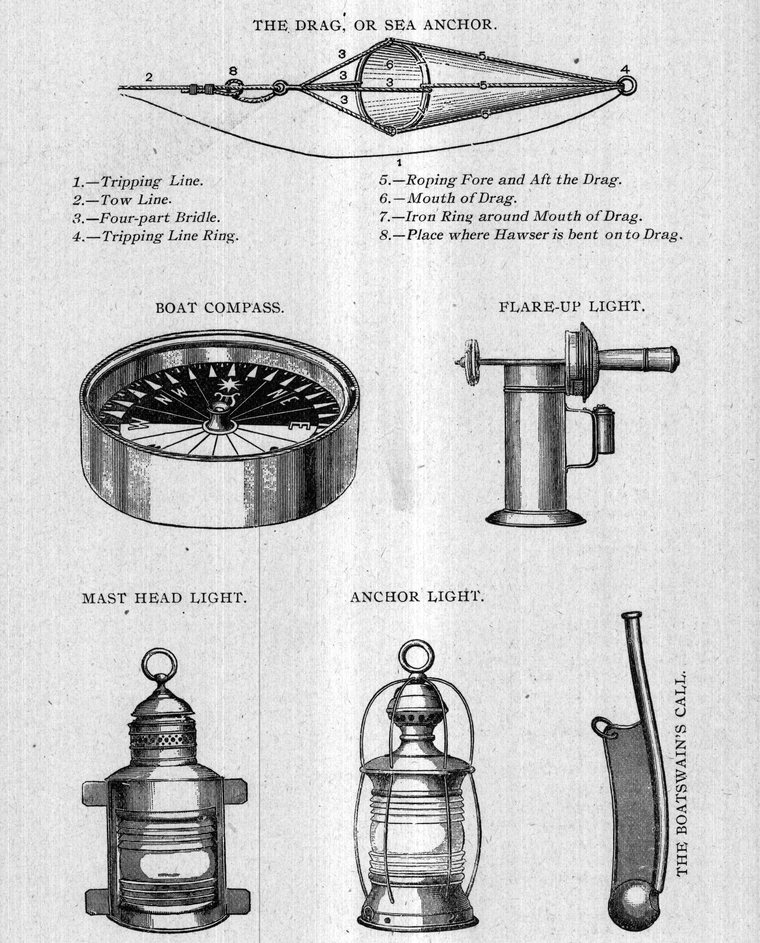
The silver whistle or pipe used by the boatswain and his mats, and which is always blown to attract attention before the verbal order is given by them.
The preface of an order issued by an officer to a boatswain, or one of his mates, to get a boat ready to send away from the ship, such as: call away the gig; call away the cutter. When the order is called along the deck the first word is omitted, and the cry made as follows: away gig: away cutter.
That state of the weather when there is an absence of wind.
Flat Calm. Not a breath of air stirring.
Dead Calm. Same as flat calm.
Fall Calm. That condition of the weather when the wind ceases.
(See Quelling Oil.)
Said of the flooring of a vessel when it is higher in the middle than at either end-towards the stem and stern.
A peculiar mechanical device for lifting a vessel over a bar; invented by the celebrated Hollander De Witt in 1688, and introduced into Russia by Peter the Great, and now in use at St. Petersburg for lifting deep draught ships over the bar of the harbor. The machine is composed of two watertight half-hulls constructed in such a manner as to permit them to be attached in a fore-and-aft direction to a vessel. The camel is filled with water until it sinks to the required depth, secured with chains to the hull of the vessel, then the water is pumped out, the camel rises and lifts the vessel. Camels vary in size from 50 feet to 150 feet in length, and from 10 feet to 20 feet in breadth, and have been known to lift a vessel 11 feet.
(See Chamfer.)
A buoy formed like a cone, and found floating over shoals and obstructions in navigation.
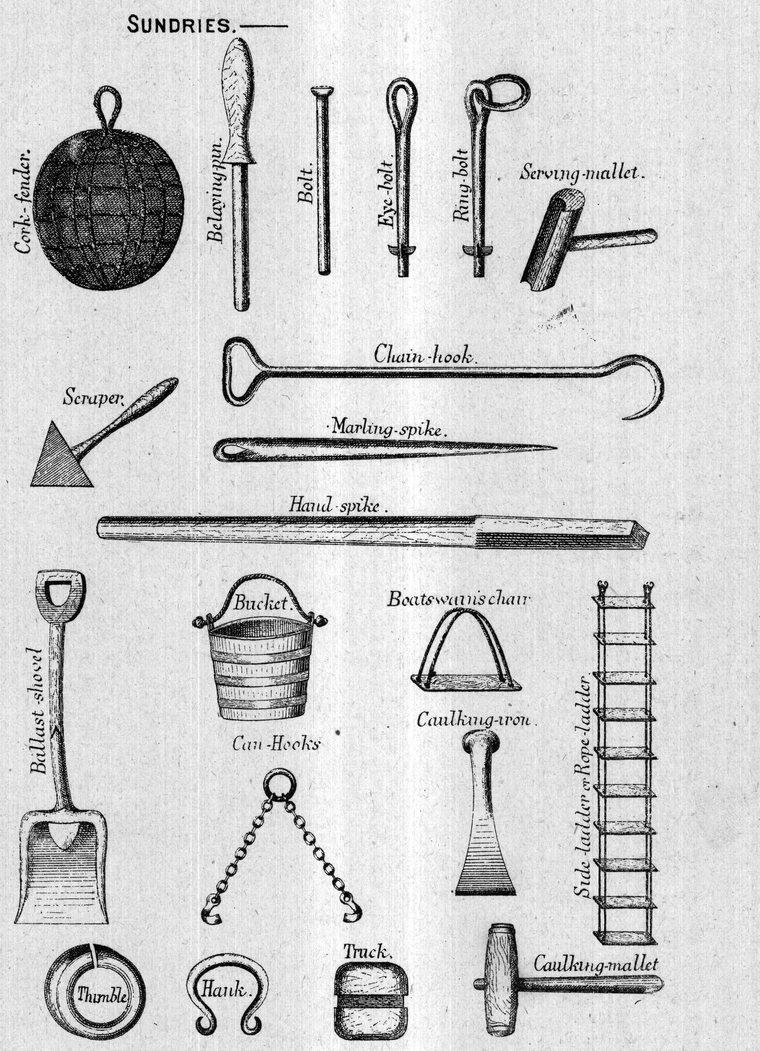
A short length of chain having a flat iron hook at each end, and used for hoisting and lowering casks by attaching the hooks to their chimes. The purchase is hooked to the centre of the slings.