Keel BlocksSea Terms
Blocks which the vessel's keel rests on in building, or when she is on a dry dock.
Page 156 of Patterson’s Illustrated Nautical Encyclopedia · 30 entries
Blocks which the vessel's keel rests on in building, or when she is on a dry dock.
A punishment at one time practiced upon heavy offenders in the English and other foreign navies. Heavy weights were attached to the culprit, then he was hauled under the vessel's bottom from one yard to the other by means of whips.
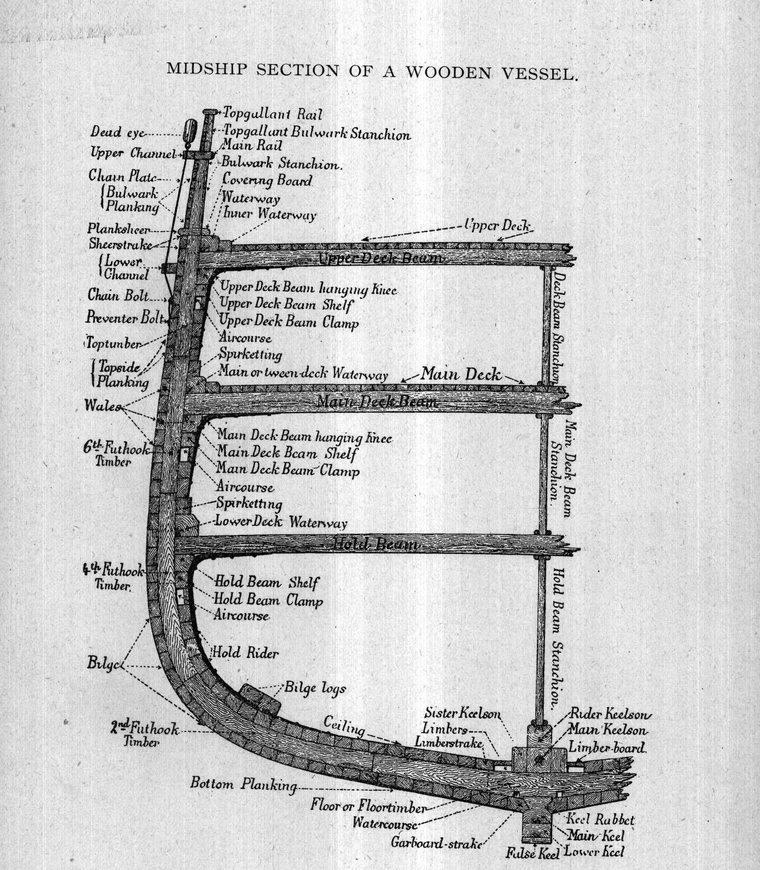
A timber bolted on top of the keel inside the vessel, and running parallel with it. (See Bilge Keelson and Sister Keelson.)
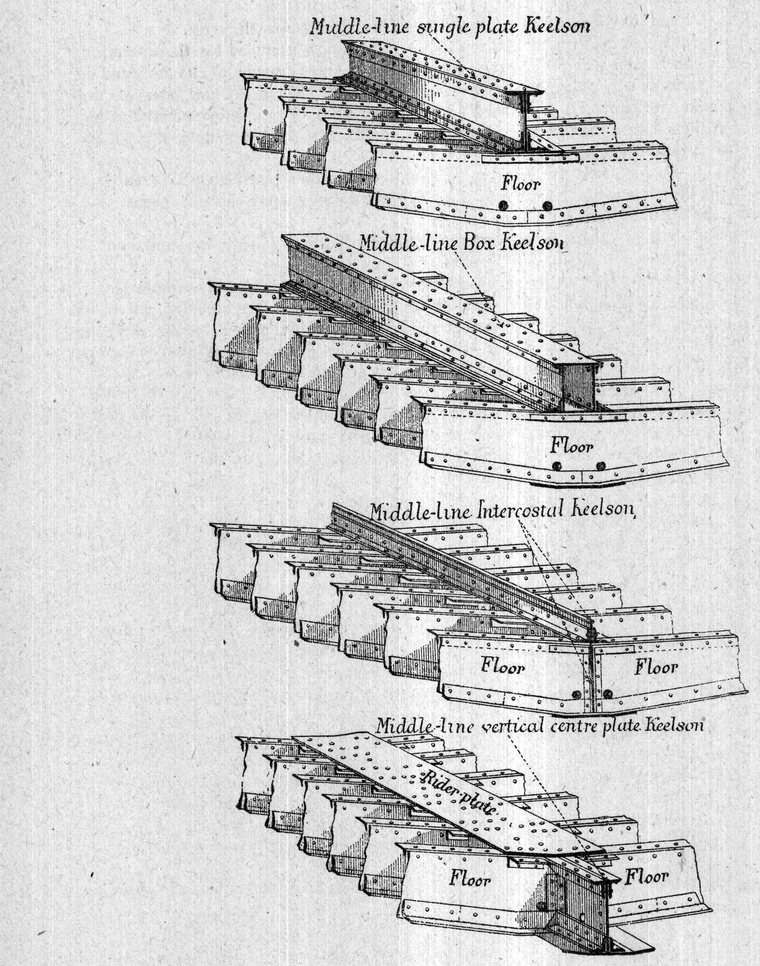
(See Keelson Riders.)
Timbers bolted on top of the main keelson, and parallel to it, in order to strengthen the keel. This is also known as keelson capping.
To put the helm up; to alter the course of the ship so as to avoid another ship or some danger.
An order given to the helmsman to keep the sails full of wind.
An order to the helmsman to keep the vessel's head more away from the wind.
To steer along a coast so as not to lose sight of the shore.
(See Hold the Luff.)
(See Hold the Wind.)
An order to the helmsman to keep the ship close to the wind so that the sails will tremble slightly.
Pig iron ballast laid alongside of the keelson.
A small pleasure vessel; a bomb vessel.
A vessel is said to be kettle-bottomed when she has a flat floor.
(See Cavil.)
(See Cavil Heads.)
An iron pin slipping crosswise through a hole in the end of a bolt to prevent it from drawing out.
A bolt fitted with a key.
A small wooden tub in which the beef and pork ration is carried into the fore-castle.
Boats used in carrying passengers on the rivers of India.
A stone anchor used in small boats.
That spoke of the steering wheel (usually distinguished by a mark) which is directly over the barrel-hub when the rudder is amidships.
The place below decks where the cooking is done. When the cooking is done in a house on deck the latter is called caboose or galley.
A twist in a rope or cable.
(See Drag.)
(See Flying Kites.)
(See Clinker.)
The staple employed in fastening the false to the main keel.
Pieces of timber having two arms, and used for connecting the beams of a vessel with the timbers.