ClawSea Terms
To work the vessel off a lee shore is to claw her off.
Page 82 of Patterson’s Illustrated Nautical Encyclopedia · 20 entries
To work the vessel off a lee shore is to claw her off.
A name given to an unfortunate whale or sealing ship having no oil or skins.
(See Open Hawse.)
When a vessel is ready for sea the customs officials must be provided with a detailed manifest (see Manifest) of the ship's cargo, which will be sworn to; then, if the port charges of the vessel have been paid, and her inward cargo properly accounted for, the collector will furnish her with a clearance document, without which she must not attempt to leave port under penalty, except American vessels under coasting license, which are allowed to sail within certain districts in the United States without entrance or clearance, provided they have domestic cargo on board.
A piece of wood bolted to a stanchion or to the deck and used for belaying ropes to.
(See Clinker.)
The two lower corners of square sails and the after lower corner of a fore and-aft sail.
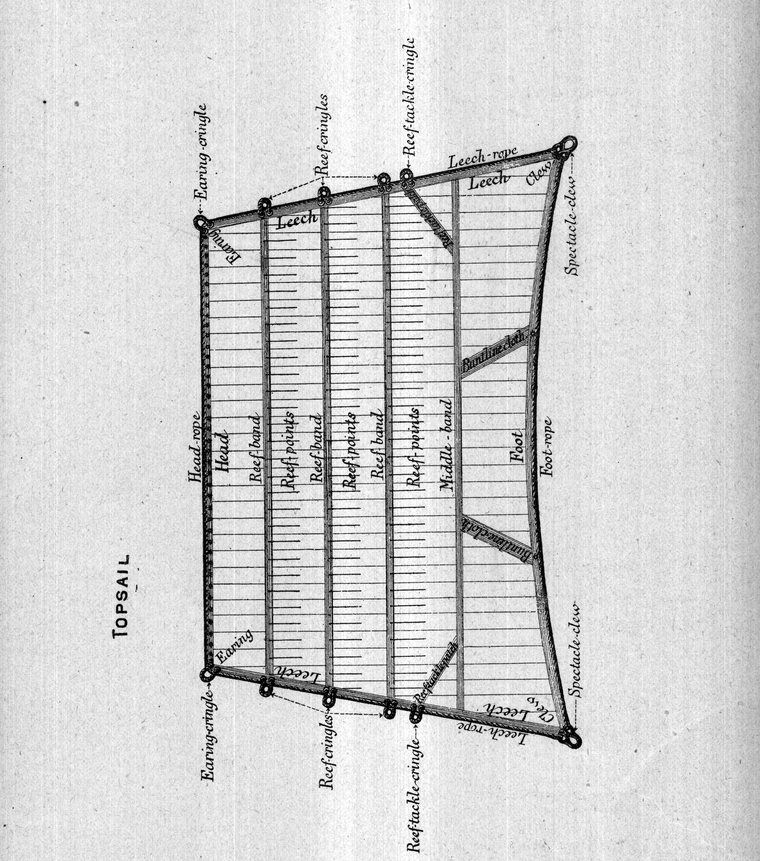
A shackle spliced into the clew of the sail which is the junction of the foot and leech.
To let go the halliards and sheet of a gaff topsail and man the clewline; the tack being kept spread, the sail necessarily comes down when the clewline is hauled on.
The rope by which the clews of a foresail and mainsail (courses) are hauled up to the yard. The clew garnet takes the place of a clewline on the courses.
To haul up the clew of a sail.
The ropes that lift the clews of square sails to the yards; the clewline bunches the gaff topsail on a fore-and-aft vessel.
To clinch a bolt is to spread the end of it over a plate by riveting, so that it cannot be withdrawn from the plate. To clinch a rope is to stop a half-hitch to its own part.
(See Clinker.)
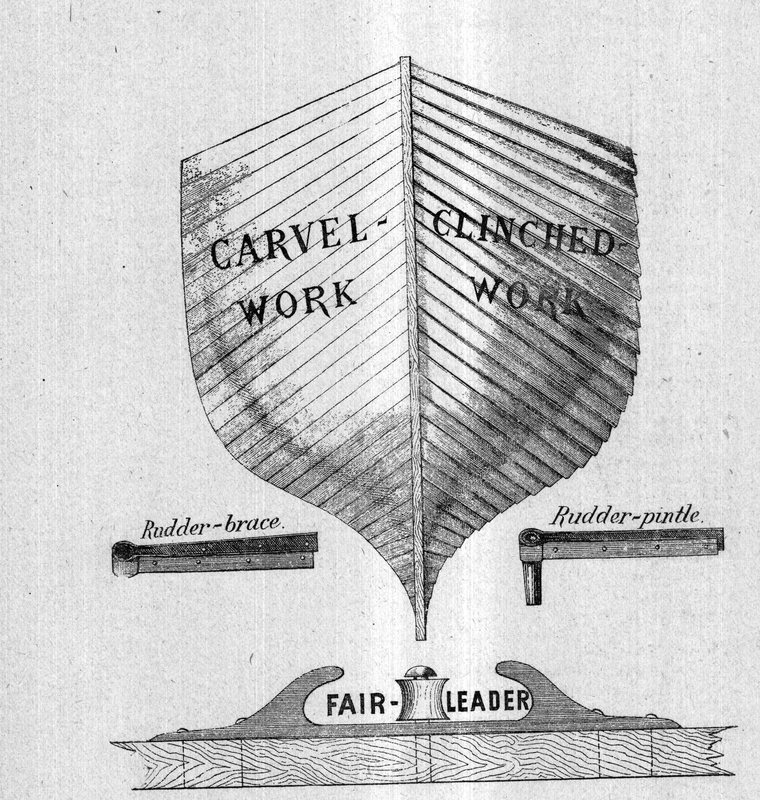
(See Clinker.)
A style of building boats in which the lower edges of one plank overlaps the top edge of the one below it.
Two regular-shaped iron hooks having one side flat, suspended (reversed to one another) from a small iron thimble. By overlapping, these two shapes form one complete enclosing hook. These are also known as sister hooks.
A vessel with a sharp bow, and built with an idea of making great speed. Said to have been first built in Baltimore, Md., hence the term Baltimore Clipper.
When a fore-and-aft vessel is sailing with her booms nearly amidships, or a square-rigger with her yards braced up as sharp as possible, she is said to be close-hauled. The same as full-and-by, on the wind, on a taut bowline.
(See Reef.)