LongersSea Terms
A name given to the casks which are stowed next to the keelson.
Page 170 of Patterson’s Illustrated Nautical Encyclopedia · 21 entries
A name given to the casks which are stowed next to the keelson.
A dock laborer or a member of a stevedore's crew.
A vessel is said to look up when by the changing of the wind she is enabled to point closer to the place of her destination.
The man on watch stationed at the bows to observe and report upon the presence and movements of other vessels, etc. (See Crow's Nest.)
A vessel looms in a fog, or at night, when she appears indistinct to the observer. The part of an oar which is inside the rowlock in rowing is called the loom of the oar. The loom of the land is known as the dark shading often seen above the horizon before the land itself appears.
To unfurl a sail is to loose it.
A Chinese coasting vessel.
Lost the Number of his Mess. When a seaman dies he is said to lose the number of his mess.
The lowest point of the tide.
To settle away; to ease down.
The second space beneath the spar deck in the interior of a vessel having two decks.
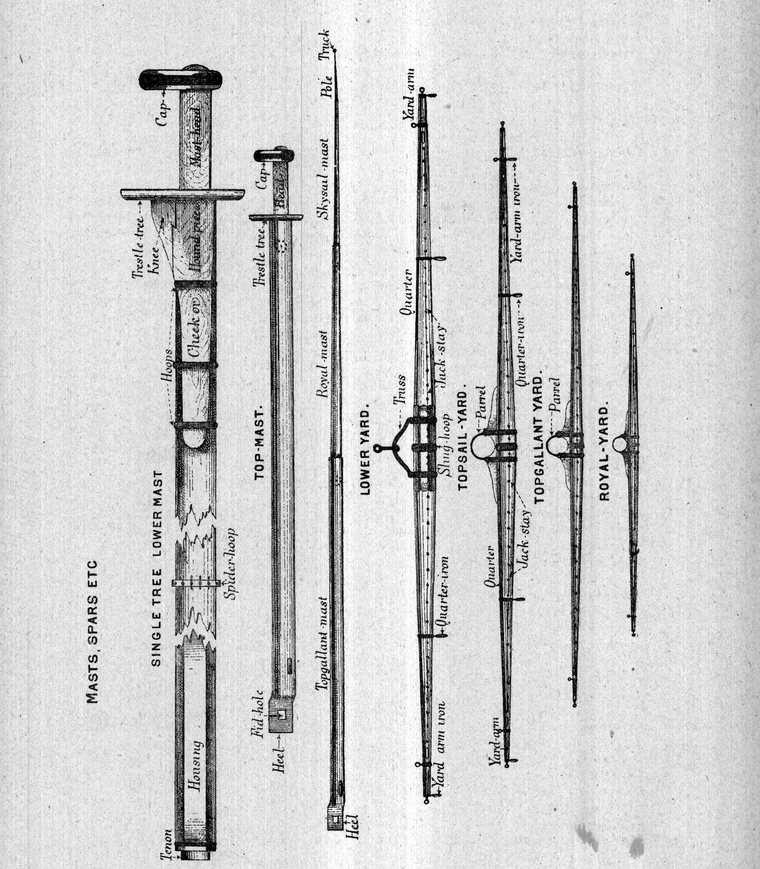
The first mast above the deck; the mast which is stepped in the keel; foremast, mainmast, mizzenmast.
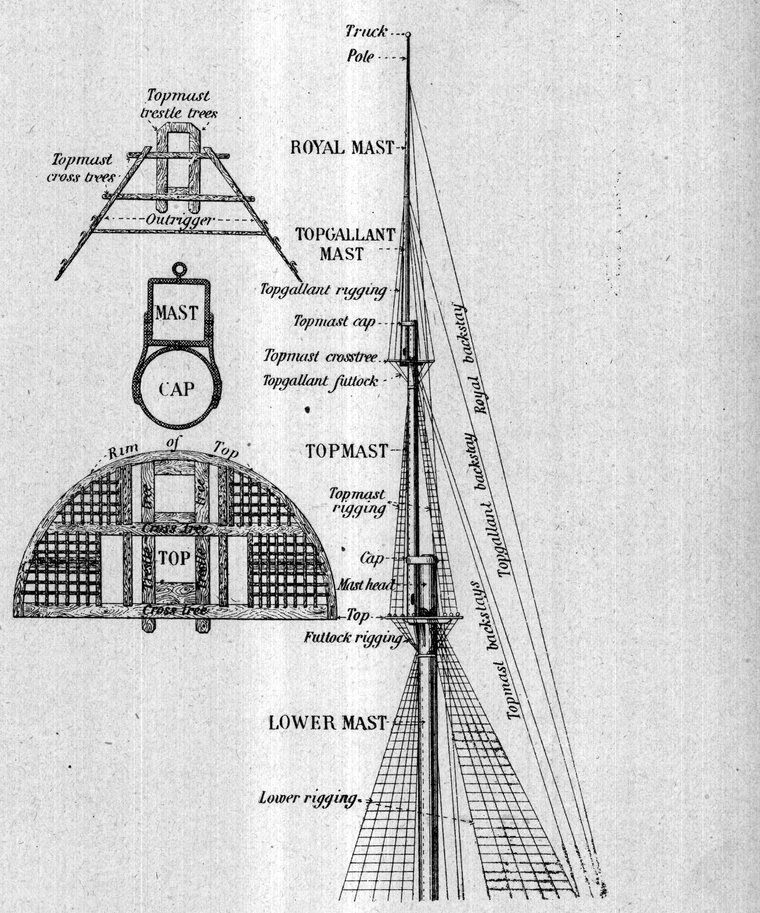
The shrouds and the ratlines belonging to the lower fore, main, and mizzen masts.
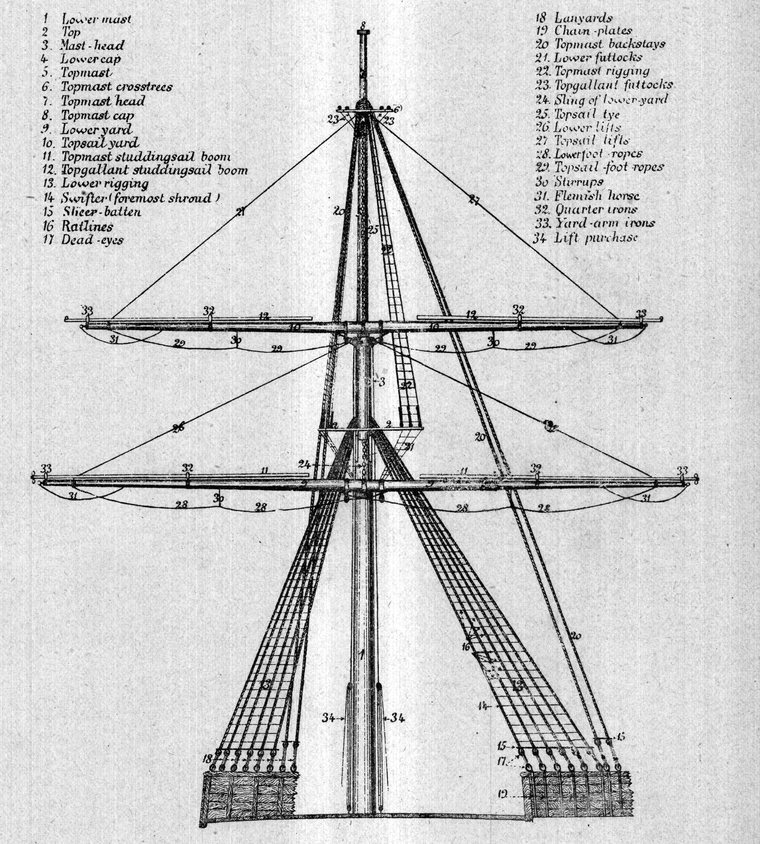
The shrouds of the lower fore, main, and mizzen masts.
(See Topgallant Sail.)
(See Topsail.)
The fore-yard, main-yard, and cross-jack.
A clumsy fellow; a green hand on shipboard. (See Lubber's Hole.)
An opening in the top next to the mast, and through which the shrouds pass after going over the lower mast head. It is sufficiently large for the passage of a man. To get into the top through the lubbers' hole instead of climbing over the top-rim by the futtock shrouds, is considered very unseamanlike, and anyone performing the first act is called a lubber by his shipmates.
The black vertical line which is painted on the inside of a compass bowl, and which represents the vessel's head to the helmsman. It seems strange that such a name, implying more or less contempt, should have been given to this mark, as it is an indispensible guide to the most experienced helmsman.
The forward edge of fore-and-aft sails; often called the forward leach. A vessel is luffed by putting the tiller to leeward and bringing her to the wind. The luff of the bow is the place where the rail begins to curve towards the bow. (See Keep the Luff and Spring the Luff.)
The iron ring or shape spliced into the bolt rope of a gaff fore-and-aft sail at the junction of the head and luff. Jib-headed sails have but three cringles, head, tack, and clew.