Passenger ListSea Terms
The names of both cabin and steerage passengers entransit.
Page 192 of Patterson’s Illustrated Nautical Encyclopedia · 52 entries
The names of both cabin and steerage passengers entransit.
A document carried by a merchant vessel in time of war to certify to her nationality, etc., as a safeguard if boarded by the belligerents; a pass to leave a harbor; an authority to remove people and chattels from a hostile country; a safe-conduct paper given to a citizen who is to travel in foreign countries.
An armed, swift Portuguese tender.
An East Indian boat for carrying merchandise and cattle.
An old character of advice boats once used in India.
A small advice boat once common in Spain.
A block in which the sheave works on friction rollers--a circle of little brass revolving wheels as a bearing for the pin.
(See Part III.)
(See Pawl.)
An iron rim or scupper around the lower part of a capstan, or around the barrel of the windlass, provided with pockets or notches into which the lower ends of the pawls fall when the capstan or windlass is hove round, and which prevent either of the above instruments from revolving backward.
A thick mat used to protect yards and rigging from chafe.
A short iron bar used to prevent a backward motion of the capstan or windlass.
To cover over anything with melted pitch, tar, etc., or to fill the seams of a vessel with pitch.
When a vessel's head falls off from the wind she is said to pay off.
To let out more cable; to slack up a towing hawser and let it run out more; to give anything like a chain or rope more scope.
A rope used for guying out the clews of the square foresail when before the wind.
(See Palm.)
A coarse sand or fine gravel.
The upper after or outer corner of a gaffsail. (See A-peak.)
Stay Peak. When the cable and forestay are parallel.
Short Stay Peak. When the anchor is nearly under the hawse hole.
The halliards on a fore-and-aft sail which hoist the out-board end of the gaff and straightens the leach.
To have the mizzen yard perpendicular and alongside the mast.
A length of rope with a block or thimble strapped or spliced into one end, the other end being secured to the end of a yard, masthead, or out-board end of a gaff. The braces reeve through the blocks on the ends of the brace pendants.
A tackle hooked on to a pendant.
A long strip of bunting carried at the masthead.
A pole driven into the bottom on a shoal as a warning to mariners.
A Thames fishing boat named for St. Peter, the patron of fish ermen.
The haddock. It is so named, because the spots on the sides are said to be the marks of St. Peter's fingers that were placed there when the Saint caught the fish for the purpose of paying tribute.
Deserting the ship when she first gets alongside of a dock after coming into port is known as making a pier head jump.
A sailor's name for a quadrant of reflection.
A pointed spar driven into the bottom, and projecting a number of feet above water.
A machine for hammering piles into the bottom.
A block of timber upon which the inner end of the bowsprit rests.
A pilot's fees.
A person familiar with local dangers along the coast, who conducts vessels in and out of port. He may be either a State pilot or a seaman licensed by the local inspectors of steam vessels.
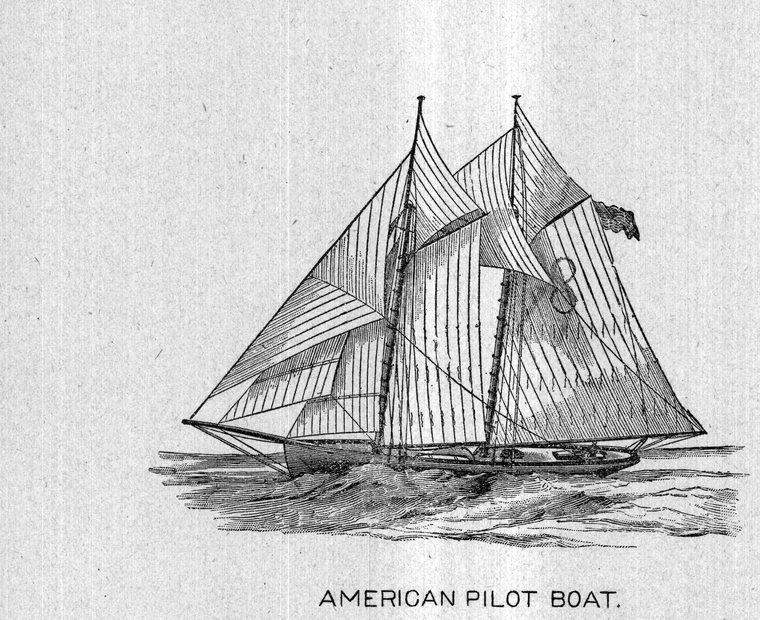
A fast sailing boat used by pilots in cruising for homeward bound vessels. The New York pilot boats have long been noted for their seaworthiness and speed, and have been known to cruise five hundred miles off shore in quest of incoming vessels.
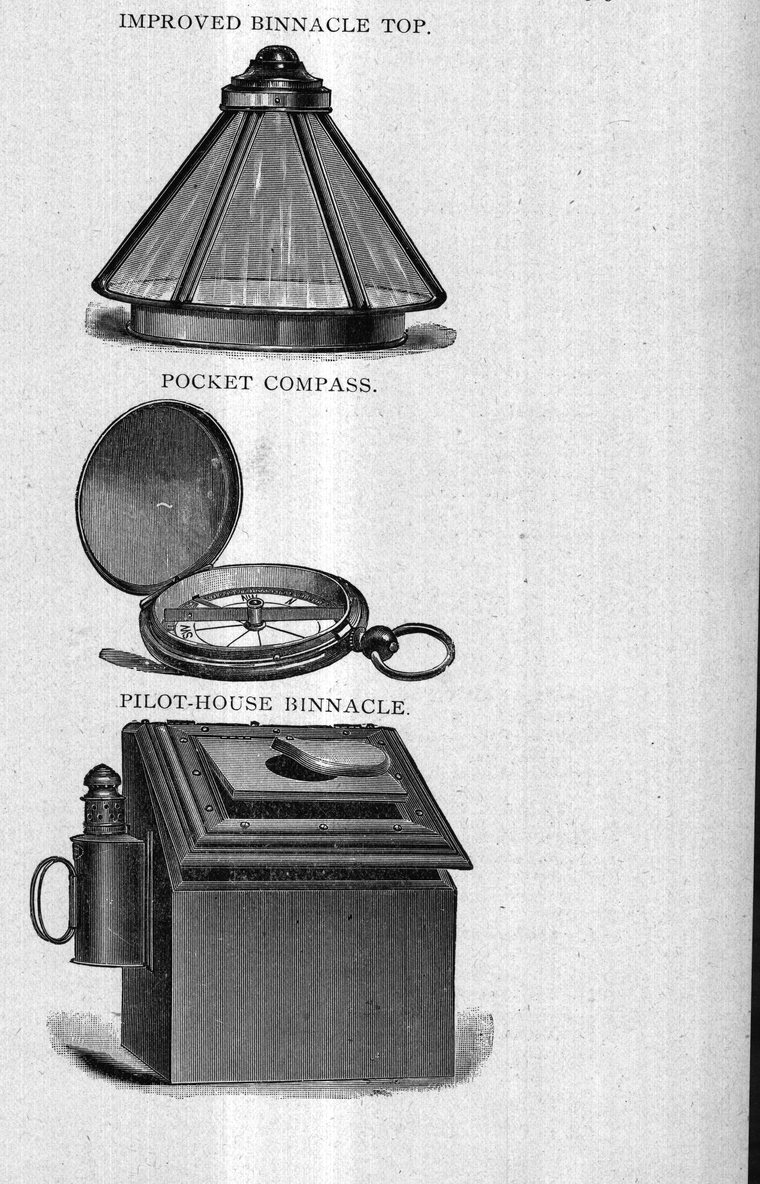
(See Wheel House.)
In the daytime the jack, or other national color usually worn by merchant ships, having round it a white border one-fifth of the breadth of the flag; or the International Code Pilotage Signal indicated by "P. T." These signals to be hoisted at the fore.
In the night time a blue light every fifteen minutes, or a bright white light flashed, or shown at short intervals, just above the bulwarks, for about a minute at a time.
To luff around a buoy or point of land when by holding the course the vessel would go to leeward of the object. When this manoeuvre is accomplished successfully it saves a tack. (See Half Board.)
The metal axle passing through the sides of a block and upon which the sheave revolves.
An order given to the helmsman to shiver the sails a little when close-hauled.
A ship (obsolete) having a flat bottom and a very narrow stern with a high house built above it, like one sees in prints of the Pilgrims' Mayflower. Hendrick Hudson's Half Moon, and such vessels.
A high, narrow stern. Also a pointed stern like that of a lifeboat, peculiar to some small American fishing schooners.
A larger boat than a cutter. It generally is pulled double banked.
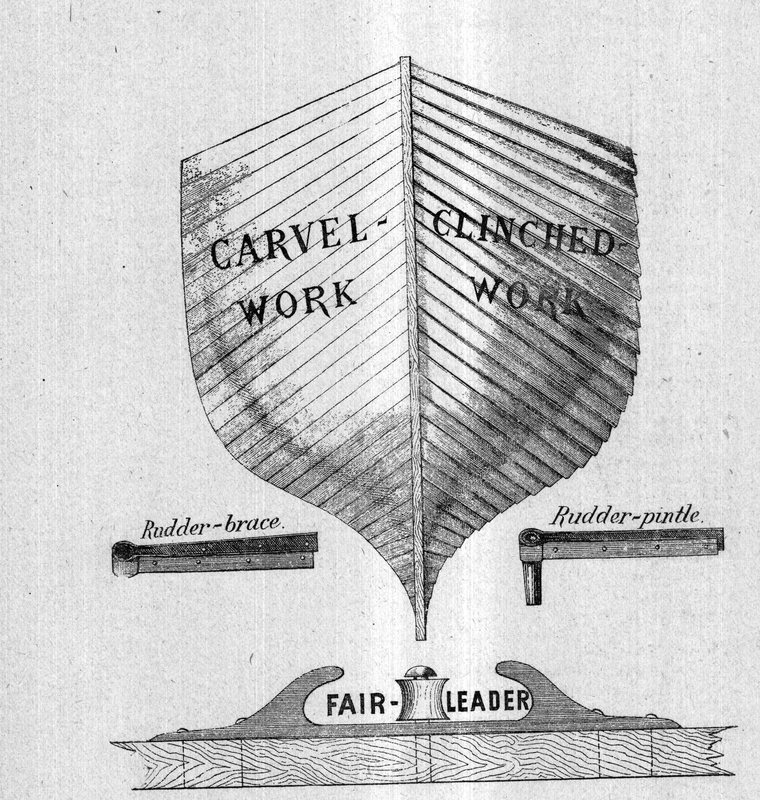
A metal bolt by which a rudder hangs.
The boatswain's whistle or call.
The conclusion of quarters or drill, when the boatswain or his mates blow the call to signify that the men are dismissed.
A sailor term for weeping.
When the commanding officer of a man-o'-war or other official dignitaries enter or leave a naval vessel the side is piped in their honor; that is, according to the official's rank, a certain number of side-boys face one another and form a hollow thwartships line from the gangway inboard, and as the official passes through this line the boatswain, or one of its mates, winds (blows) his call and the side-boys salute. The ceremony is under the immediate charge of the officer of the deck.
(See Quarters.)
A robber; a freebooter of the seas.
The ship of a sea-robber; an unlawful plunderer. (See River Pirate.)
A substance obtained from the pine tree, and boiled down to such a consistency as to become hard and dry when cool. It is melted, then poured into the seams of a vessel's decks and planking after caulking.