SaggedSea Terms
Said of a vessel when she droops amidships, so that the line of her shear settles at that point--opposed to hogged. (See Hogged.)
Page 216 of Patterson’s Illustrated Nautical Encyclopedia · 27 entries
Said of a vessel when she droops amidships, so that the line of her shear settles at that point--opposed to hogged. (See Hogged.)
A ketch of the Levant.
A covering of canvas placed over sails when they are furled so as to add to their neatness, also to protect them more or less from dampness.
Sail Ho! A cry used in reporting the first appeaarnce of a sail at sea.
(See Mast Hoop.)
(See Out-Point.)
When a vessel is so trimmed as to do her best sailing--as a rule referring to the amount and disposition of her ballast. It may also mean the trim of her sails.
A splice made by sailmakers in uniting two ropes of different sizes.
The canvas suspended from yards, spread by gaffs and booms, and hoisted upon stays. The first are called square-sails, the second fore-and-aft sails, and the third staysails. (Look under various headings.)
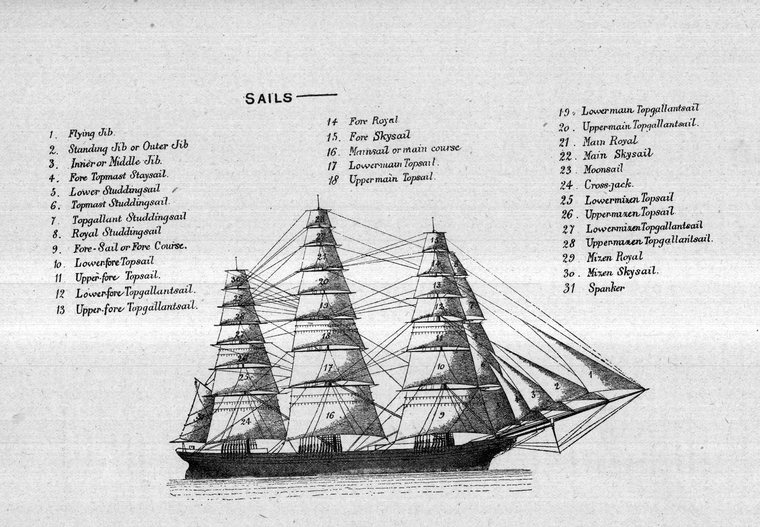
(See Deck.)
A sailor.
A sailor's term for the salt beef issued to the crew.
Soap made from cocoa-nut oil and which makes a good lather when used with salt water.
A percentage of the value of a ship and cargo awarded under certain circumstances to one or more individuals who have been instrumental in saving the vessel.
A Turkish coasting vessel.
An Arab pinnace.
A small Chinese boat with a house built over nearly its entire length.
A long, narrow open boat with two masts seen on the coast of Barbary.
Sargasso in Spanish means sea-weed, and the sea-weed seas are found in both the Atlantic and Pacific Oceans. In the Atlantic the confine of the Sargasso Sea may be roughly stated as between the 20th and 70th meridians, extending in latitude about 5 deg. on either side of the Tropic of Cancer. In the Pacific this sea is confined between the meridians of 140 deg. and 175 deg. west, and extends from the Tropic of Cancer to 40 deg. north. In certain parts of the Sargasso Sea this floating weed is so thick that it requires a good breeze of wind to force a sailing vessel through it.
(See Water Sail.)
(See Part V.)
A Neapolitan galley.
To haul up the tack or to drop the peak of a fore-and-aft sail. To goose-wing a square sail by hauling up one of the clews.
When the wind hauls so that the vessel is obliged to brace up to head her course the wind is said to scant.
(See Part V.)
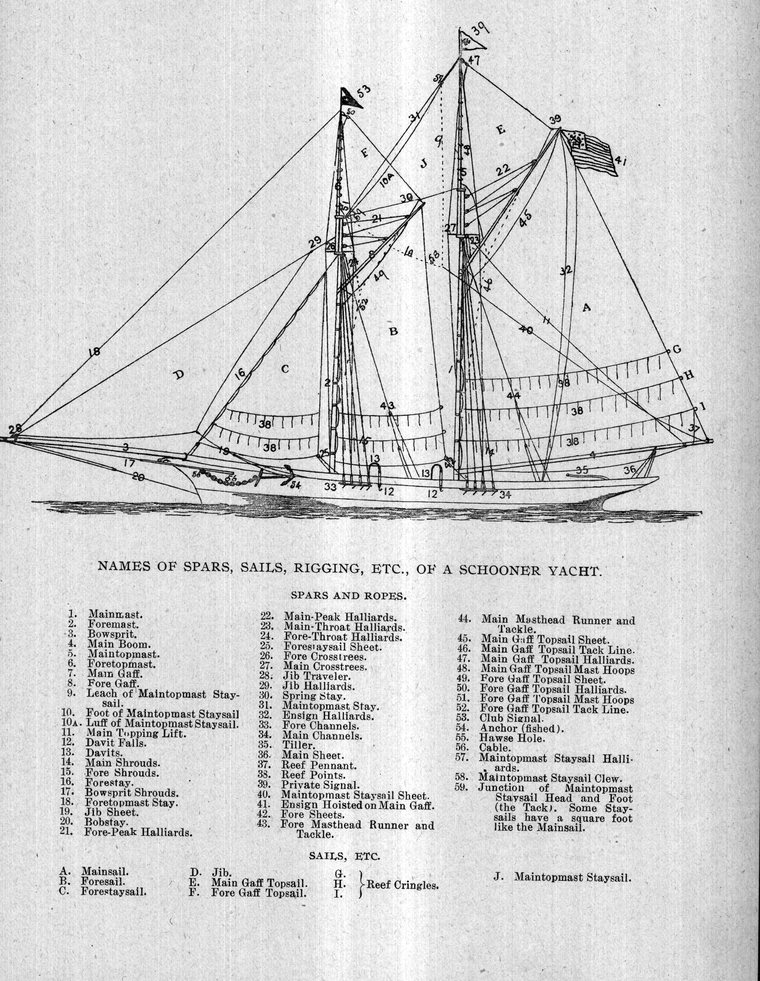
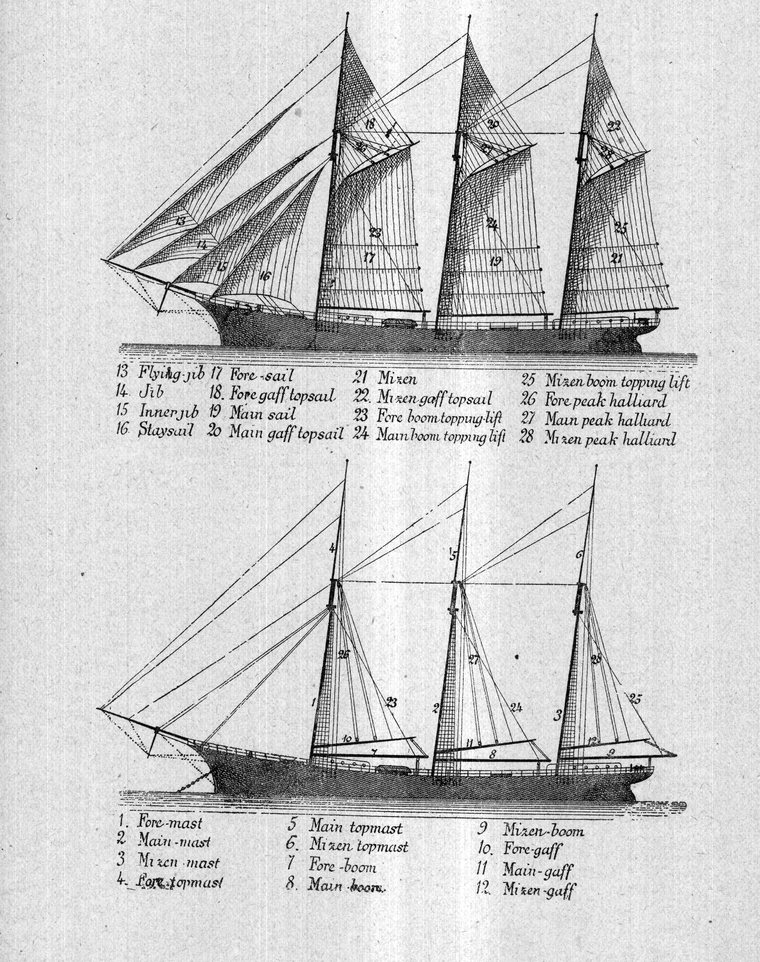
A rore-and-aft schooner has no yards, all her sails being spread by booms and gaffs and by hoisting upon stays.
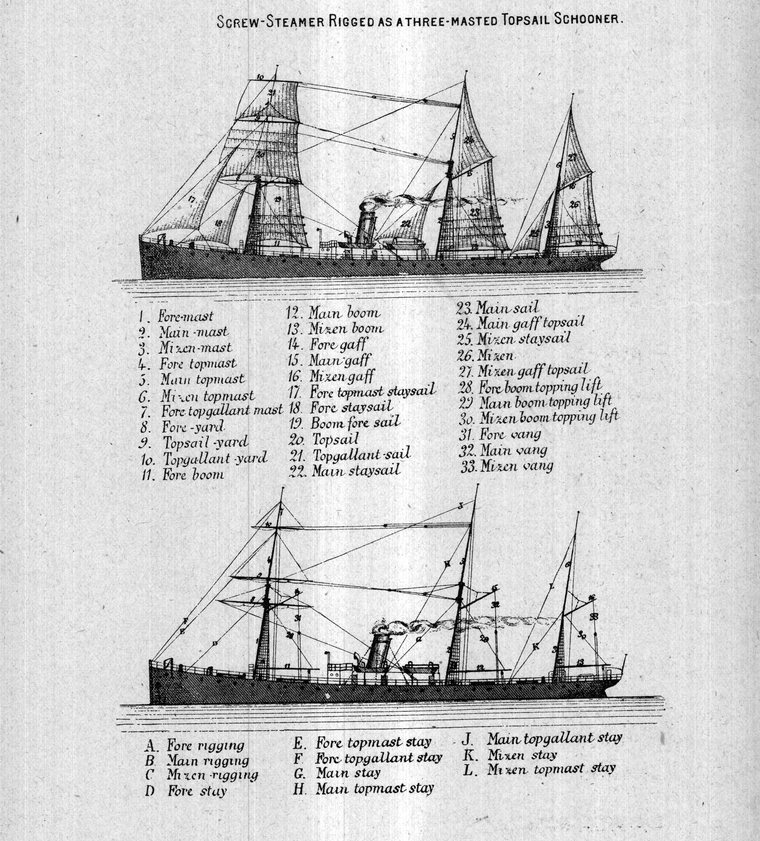
A topsail schooner carries a fore-and-aft foresail and mainsail, a square fore-topsail and topgallant sail and sometimes a royal.
A main topsail schooner carries a square topsail on the main.
Fore-and-aft schooners carry from two to five masts.
A Dutch galiot. (See Dutch Galiot.)
A small boat with three lateen sails found in the Levant.