Slack ClothSea Terms
A certain quantity of canvas allowed to be gradually gathered up in sewing on the bolt rope of a sail, otherwise the rope by stretching in the wearing might occasion the sail to split.
Page 234 of Patterson’s Illustrated Nautical Encyclopedia · 27 entries
A certain quantity of canvas allowed to be gradually gathered up in sewing on the bolt rope of a sail, otherwise the rope by stretching in the wearing might occasion the sail to split.
The interval between tides when the water is stationary.
A favorable breeze.
(See Slaver.)
A vessel engaged in the slave trade; the term may also be correctly applied to a person engaged in the slave traffic.
The lowest tier of casks or barrels in a vessel's hold.
(See Companion.)
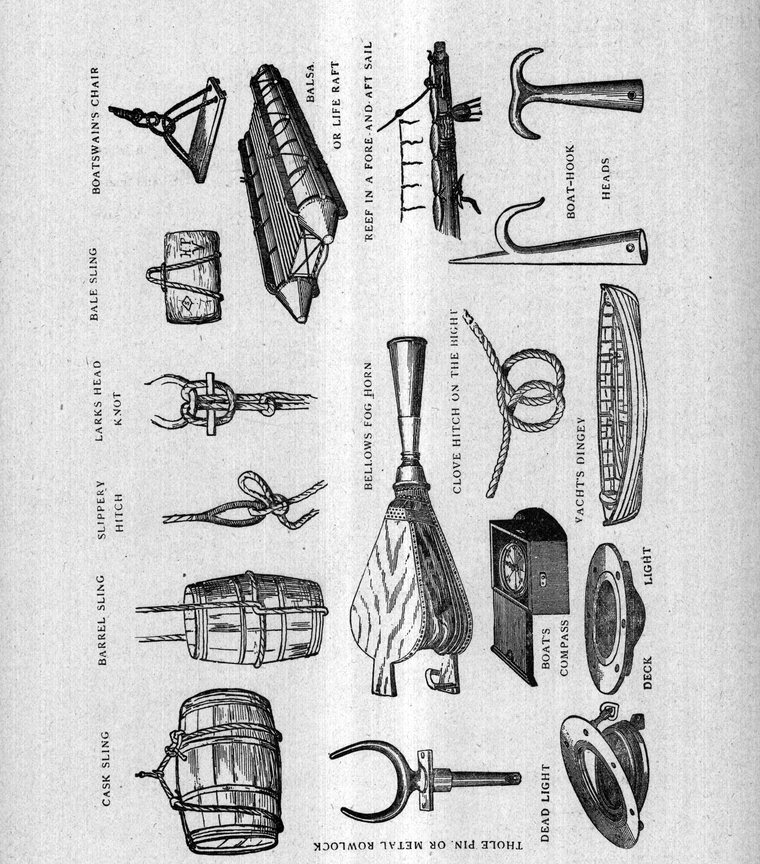
To suspend a cask or other article in ropes or chains. (See engravings of cask-sling, barrel-sling and bale-sling.)
The chain which connects the centre of a yard with the mast. Also a length of rope having the ends spliced together--known also as a strap.
To slip the cable is to unshackle it and let it run out.
A knot that slips along a rope around which it is made.
The lost motion of the propeller. The difference shown between the distance run by log or observation and the distance made according to the number of revolutions shown by the propeller. Head-winds, head-seas and opposing currents are counted as slip.
A rope arranged in such a manner that it may be let go suddenly.
A hitch made by a landsman, or novice on board ship, which will not hold. Also a loop or half-bow knot tied in a rope after passing it around or through something which will not jamb, and which will untie by pulling the hanging end. (See engraving.)
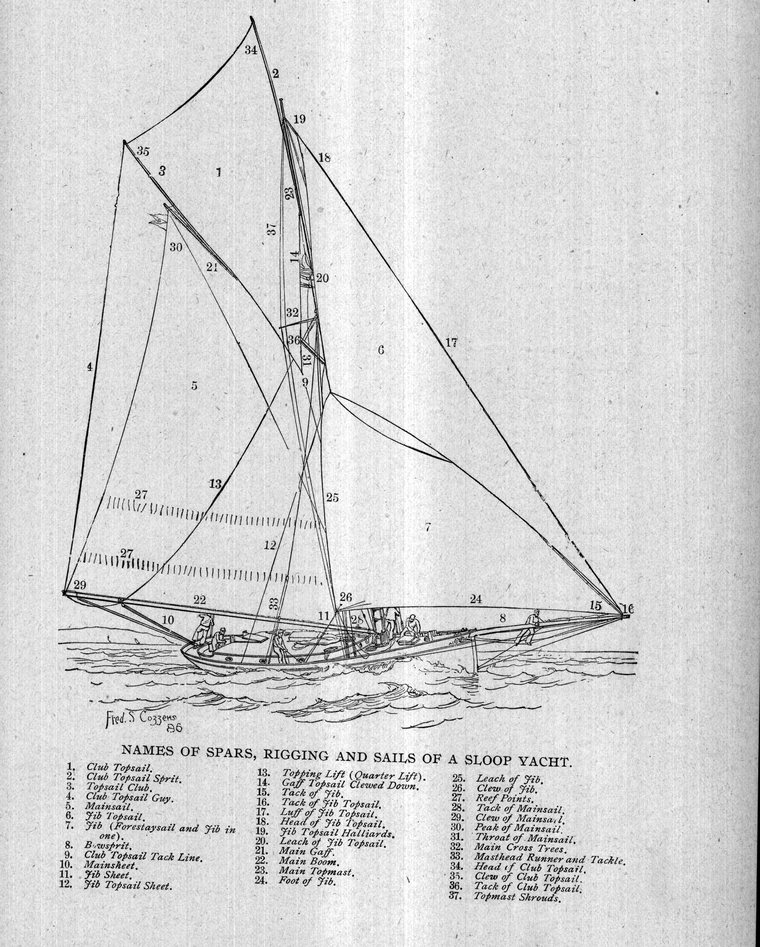
A vessel with one mast. (See engraving, Part I.)
The place in which the slops are kept on board ship.
Ready-made clothing and small stores, like knives, tobacco, etc., carried on deep-water ships and sold to the crew by the captain upon application.
To turn around.
The small iron gates or openings in the bulkheads of a vessel to allow the bilge water to circulate along the keelson; they are closed in the event of fire or upon springing a leak.
The grease skimmings of the cook's coppers or pots when salt pork and beef are boiled. Slush is employed to grease down a mast, etc., also used as lard in the galley cooking.
The tub in which the slush is kept.
A small fishing or trading vessel, sloop or cutter rigged.
A vessel takes a small helm when she is sensitive to it, requiring only a spoke or two to control the ship. Also an order given to the wheelsman cautioning him to be gingerly in putting the helm over to port or starboard.
A term given to marline, spun yarn, houseline, etc.
The line which breaks out a yarn-stopped sail.
The pipe of a steamship through which the smoke from the fire-room furnaces escapes. (See Funnel.)
During ocean gales, when very high seas are running, it has been observed that every few minutes a kind of lull, called a smooth, takes place in relation to the sea, and that these lulls occur after about every third sea. Vessels intending to heave to after running in a gale wait for one of these smooths, and when it comes to them they put the helm down and come-to in a much easier and safer manner than by manoeuvering the vessel so as to encounter the full force of the trough.