St. Elmo's Light, or FireSea Terms
(See Corposant.)
Page 242 of Patterson’s Illustrated Nautical Encyclopedia · 30 entries
(See Corposant.)
A large awl used by sailmakers to pierce holes in canvas.
A light flag pole.
A vessel is said to stagger under a press of sail when she has as much canvas set as she will bear.
A boat flying a distinguishing flag or mark, anchored at a distance from the race committee's boat; between the two an imaginary line exists over which the vessels cross after the starting gun is fired.
Seaworthy, strong, watertight, able.
Posts of wood or iron which support a vessel's beams, or the bulwark rail, and to which the bulwarks are secured.
An order given to the crew to attend, prepared and waiting for orders.
To stand on is to hold the course.
The part of a rope or cable which is secured to something is known as the standing part; the part of a hook opposite to the point; the part of a tackle which is secured to the block.
Stays which set up abaft the shrouds on each side, and support the mast when the vessel is under sail.
A fixed bowsprit: one that does not run in and out.
Gaffs kept throated and peaked aloft on which fore and aft sails are set by means of an out-haul, and furled by means of brails. These sails have no booms. (See Railways.)
The regular working topsail which hoists upon the topmasts by hoops, its foot being spread by the gaff.
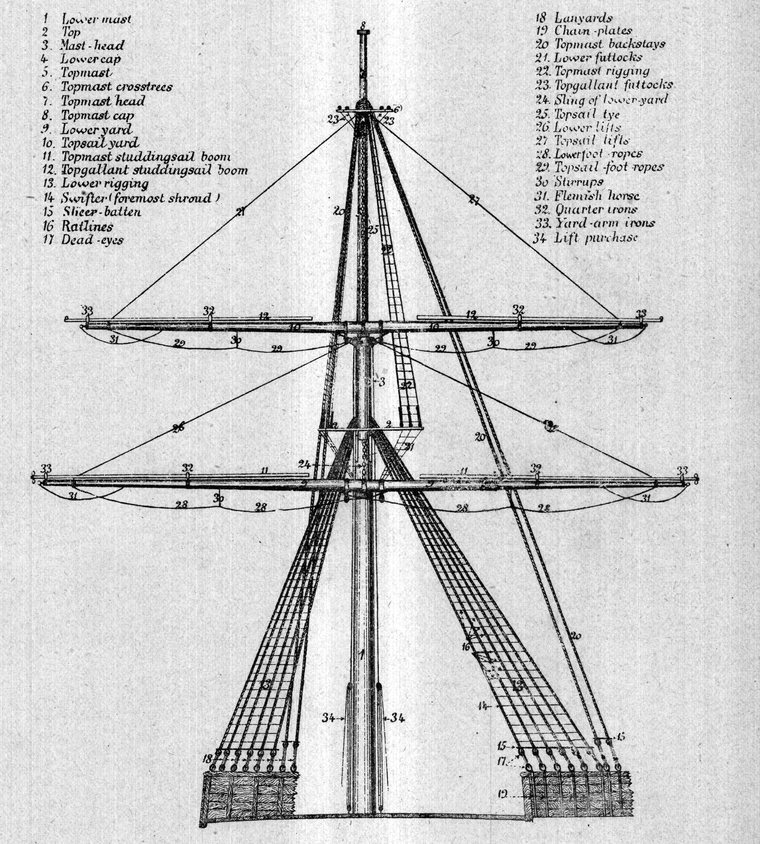
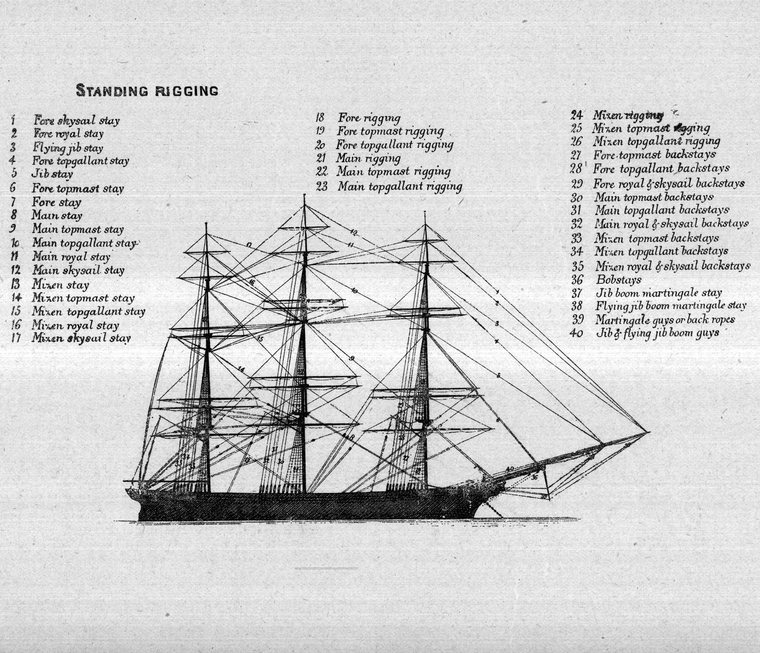
Stays, shrouds, etc., which are secured permanently, and not hauled upon.
The right hand side of a vessel when looking forward.
Having the starboard tack of a square-sail on board. Sailing with the wind blowing on the starboard side.
To put the helm to starboard.
A term given to the men of the starboard watch.
To start a sheet is to slack it off a little. A term used in racing to signify the commencement of a race. To start a barrel is to open it. To start a butt is to have the end of a plank loosen itself from the side.
Start from Anchorage. Upon a given signal the vessels commence the race, starting from their anchorage.
(See State Training Ships.)
School ships fitted out under State authority and expense for the nautical education of young men--a branch of the public school system.
A written or printed form showing the respective stations for the crew for various evolutions.
The officers and men belonging to a particular station of the Life Saving Service.
(See Dock).
An order to the crew to take stations for tacking the ship.
(See Stove.)
To stay a vessel is to tack her; to stay a mast is to support it sideways, forward and aft.
Small holes worked in the luff of staysails to secure the hanks which fasten the sail to the stay.
(See Peak.)