TruckleSea Terms
A Welch coracle of light frame and covered with leather.
Page 255 of Patterson’s Illustrated Nautical Encyclopedia · 23 entries
A Welch coracle of light frame and covered with leather.
The name applied to a cabin half above and half below the upper deck.
(See Tree-nails.)
The projections on each side of a cannon which rest upon the gun-carriage and support the piece, permitting it to be elevated and depressed.
An iron fixture which holds the centre of a lower-yard to the mast.
A gaff to which the head of a trysail is bent.
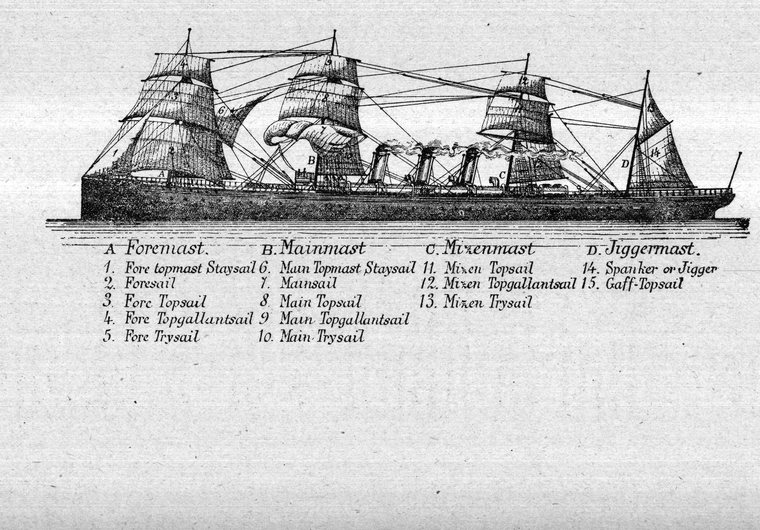
Fore-and-aft gaff-sails which are carried on the fore and main masts of a ship, hoisting on small masts (trysail-masts) abaft the lower mast. These sails are also known as spencers, while the fore-and-aft sail carried at the mizzen mast of a ship or bark is called a spanker. But all these sails are referred to as trysails when set during gales of wind, in order to lay the vessel to or to head-reach under them.
To exert spasmodic force upon anything. A small towing vessel.
Tugging at her Anchors. For a vessel to strain at her cables when at anchor in a storm, or when riding to a very strong tide.
(See Falling Home.)
A short, confused sea.
A small boat of Borneo.
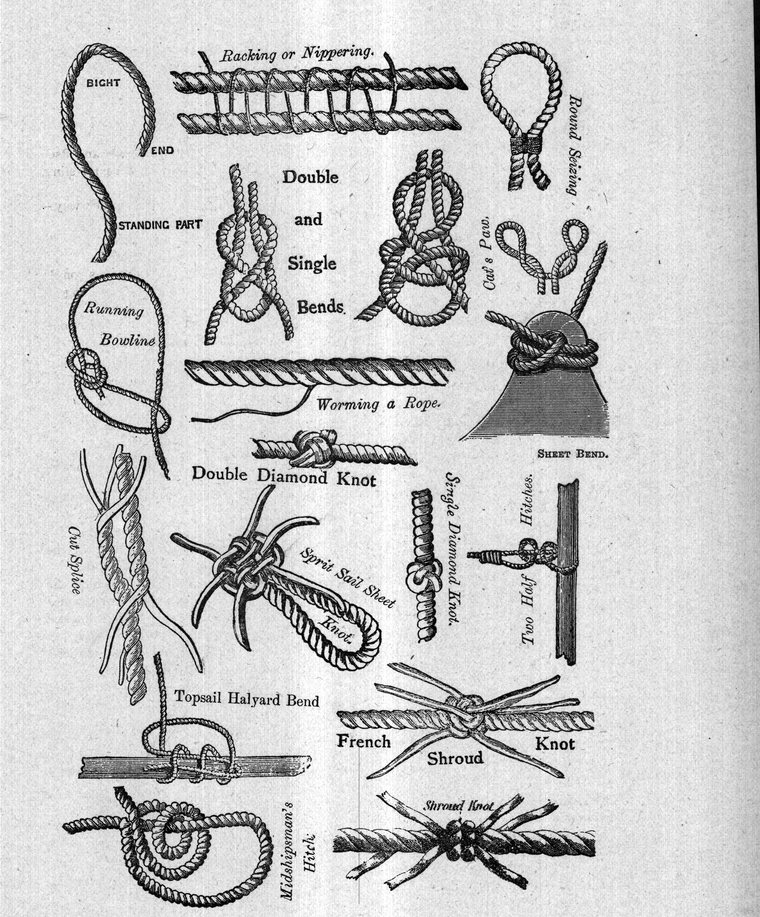
A fancy knot made in the upper end of man ropes, etc. (See engraving.)
To pass a rope or chain around a pin or bitts as a fastening for the former is known as catching or taking a turn. To turn turtle, to capsize. To turn in, to go to bed. To turn out, to get up. To turn in a dead-eye, to strop it with the end of a shroud. Turn of the tide, the change in the direction of its flow. Turn ahead, the slow forward movement of the propeller or paddle-wheels. Turn the glass, to capsize the sand-glass when heaving the log. Turn up all hands, to get all the crew on deck. Turn-to, to commence work.
A simple mechanical device of a thread and screw kept permanent on standing rigging for setting it up.
An imposter, gotten up to look like a sailor, and soliciting charity.
A vessel is said to turn turtle when she capsizes. (See Turn.)
(See Part II.)
Rope laid up from old yarns.
An exaggerated tale. (See Yarn.)
(See Chock-a-Block.)
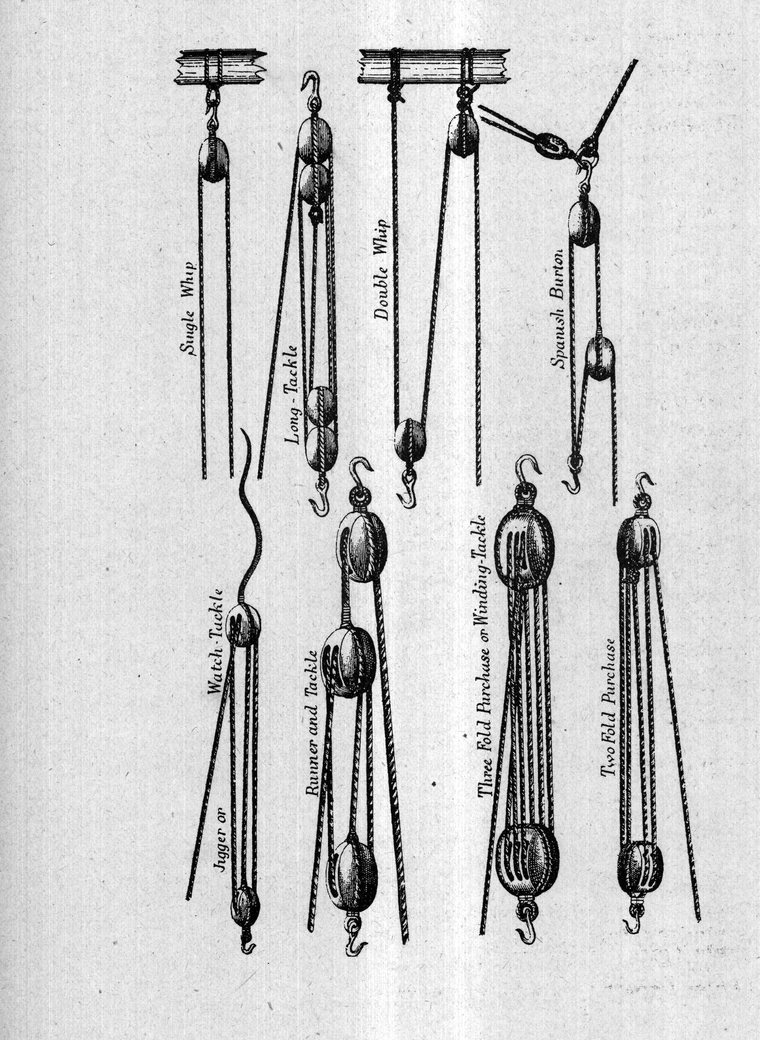
A block of two sheaves.
A purchase having two double blocks.
Often used as a mooring hitch. It is made by passing the end of a rope around the standing part and bringing it up through its own bight, and then repeating the latter part. (See engraving.)