Wind a ShipSea Terms
To change a vessel's position by bringing her head where her stern was.
Page 265 of Patterson’s Illustrated Nautical Encyclopedia · 60 entries
To change a vessel's position by bringing her head where her stern was.
Being prevented from sailing by a head-wind.
The situation of a ship when she rides to the wind independent of the current or tide.
A long funnel-shape canvas leading below through one of the hatches, kept spread by wooden hoops, and used for sending fresh air below decks. An opening in its upper part, or head, admits the air which is gathered by two large canvass-flaps or ears, standing out on each side, and trimmed by bowlines. The windsail hoists by halliards, and is slued around as often as necessary to face the wind.
(See Signals.)
The boatswain is said to wind his call when he blows it. The first word is pronounced the same as the first word in the sentence "wind the clock."
The machine by which an anchor is weighed. (See engraving; see Capstan.)
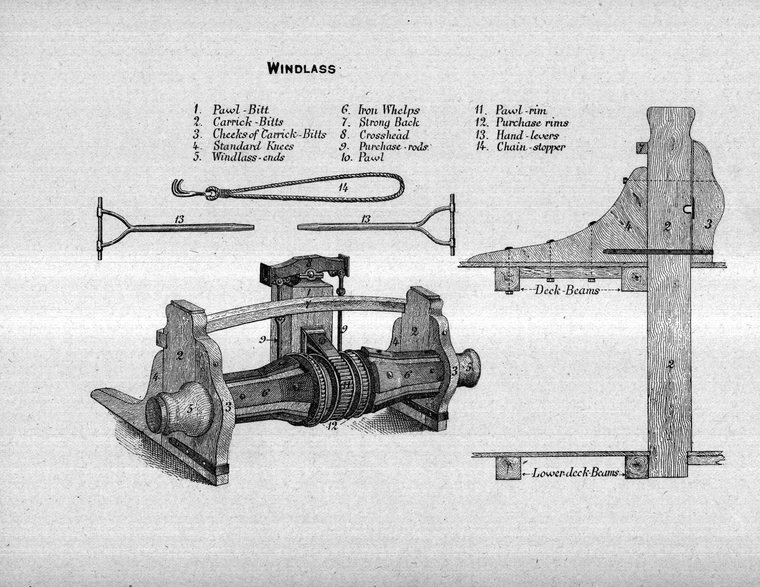
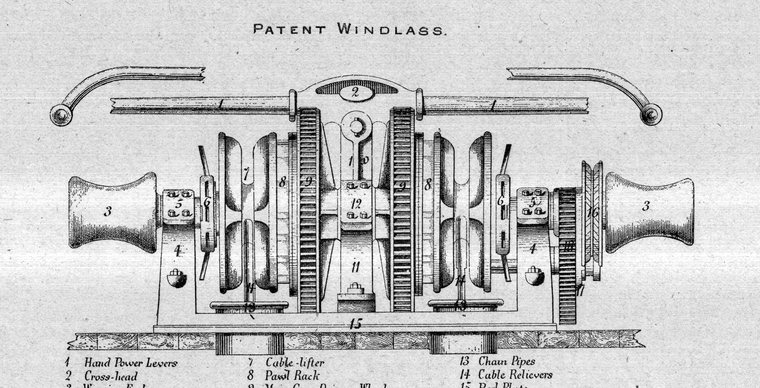
The upright supports for the barrel of the windlass. These uprights are also known by the names of carrick-heads, carrick-bitts, and wind-lass heads.
A combination of a windlass and capstan, in which the windlass moves the spindle of the capstan by gearing.
The exact point from which the wind blows.
The point or direction from which the wind blows.
A tide that sets to windward. (See Weather Tide.)
The part of the hold next the side.
Said of a fore-and-aft vessel when she is sailing with her booms out on opposite sides.
The casks or barrels which are stowed in the wings.
Standing rigging of wire-rope, which has almost entirely taken the place of hemp standing rigging.
A rope laid up from right to left is said to be laid up with the sun. When the wind shifts around the compass in the same way that the hands of a watch revolve (from north to south by the way of east) it is said to shift with the sun. The sun is supposed to move from right to left. (See Against the Sun.)
(See Wythe.)
A block of wood bolted to the rudder-stock underneath one of the pintles so as to prevent the rudder from unshipping.
The winding of rope around a spar after it has been fished.
To make progress against the wind.
Handling the yards and sails and rudder.
The regular jib-one of the head-sails. (See Jib.)
All the regular sails of a vessel excepting such as are rigged specially in light breezes. Under the latter head would be studding sails for a ship, and club-topsails and balloon-sails for fore-and-aft vessels.
Known also as the standing and the gaff-topsail, in distinction to the sprit or club-topsails which are hoisted from the deck and set flying.
To make spun yarn, etc., out of the strands of old rigging. Also to keep a man constantly at work at dirty or needless jobs as a punishment. (See Riding Down.)
Filling up the lays of a rope with spiral windings of small stuff (called worming), so as to make a flush surface.
Destruction of a vessel in part or whole.
Spars, cordage, sails, cargo, etc., belonging to a wrecked vessel.
The term may be defined in two ways. One who seeks to draw vessels ashore by false lights, for the purpose of plunder. One legitimately employed in raising sunken vessels and saving their cargoes.
To strain anything unduly or to twist out of shape. To wring a mast is to buckle it by setting the shrouds up too taut.
An iron ring fitted to the end of a boom as a cap, through which a spar is rigged out.
An armed coasting vessel of the Mediterranean.
A vessel used for pleasure, or a vessel of state.
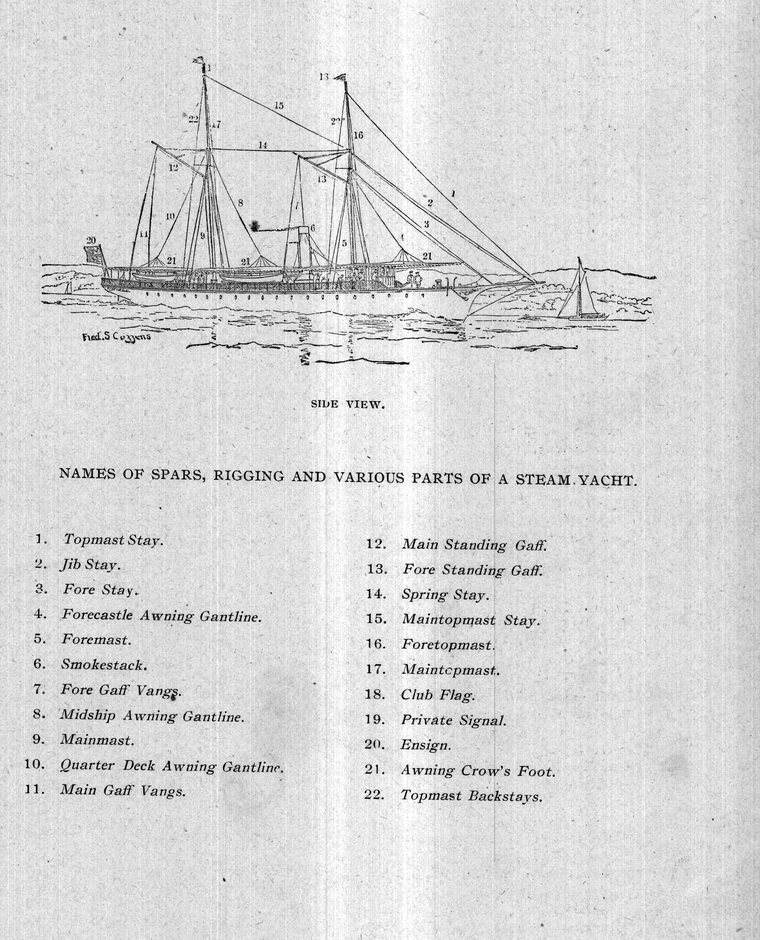
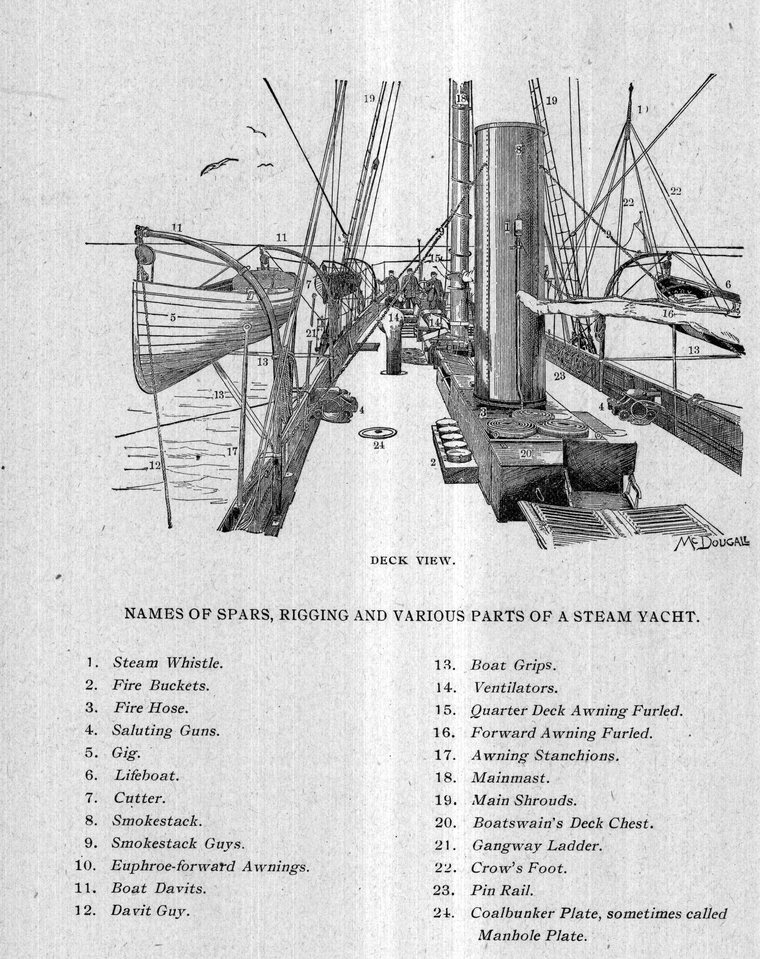
(See Ship Plumbing.)
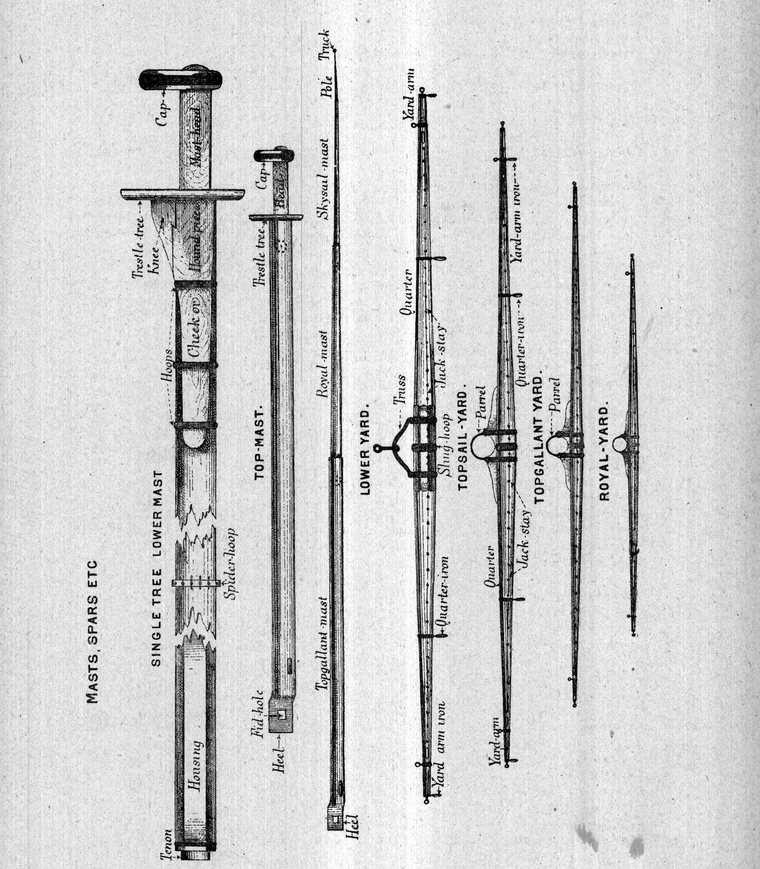
A spar suspended horizontally to the forward side of a mast, and to which the head of a square-sail is bent. Yards also spread the foot of the sail next above. They are hoisted by halliards, turned by braces, and supported by lifts. The middle of the yard is called the slings, the ends of the yard the yard-arms, and between the slings and yard-arms the quarters. Lower yards are hung in a truss, and the upper yards confined to the mast by parrels. There are lower-yards, topsail-yards, topgallant-yards, royal-yards, and skysail-yards. (See Double Topsails, Double Topgallants.)
A yard is a-box when its sail is aback.
(See Arm.)
Said of vessels when they are lying alongside of one another so that their yard arms touch.
The rope used in sending up and down yards.
A heavy tackle hooked into a strop on lower yards, and used for hoisting great weights.
A boat fitted with lug sails and used in the herring fishery.
A tale. To spin a yarn is to relate a story. (See Rope Yarn, Twister.)
A vessel yaws when, from indifferent steering, or a heavy sea running under the quarter, she makes a crooked track through the water.
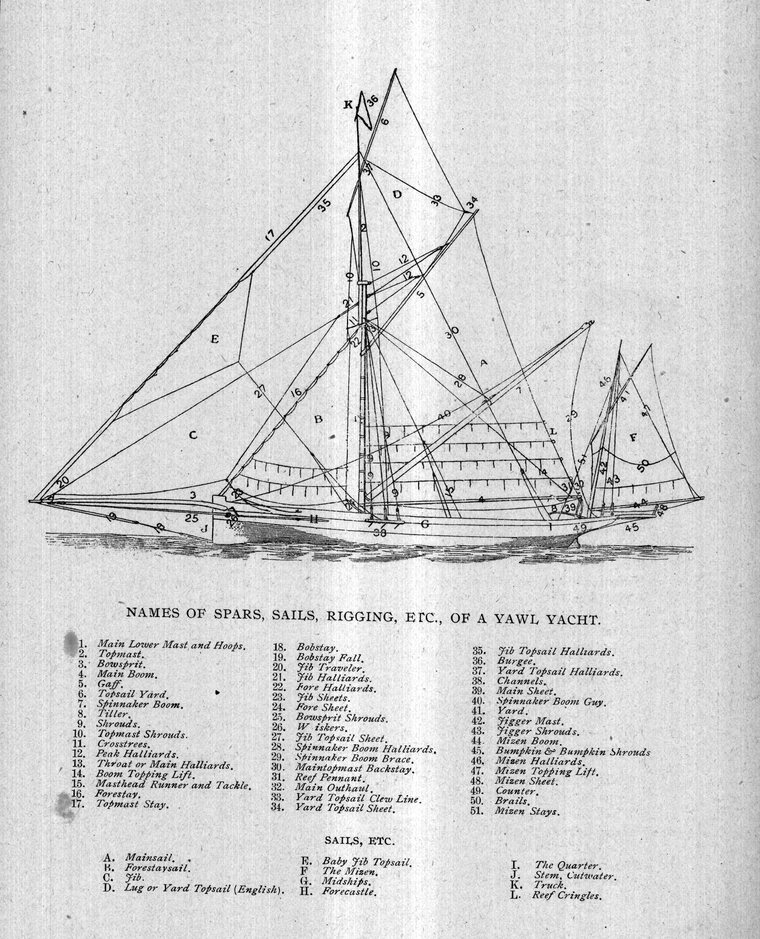
A small fishing vessel. A cutter with an additional fore-and-aft sail set on a mizzen or jigger-mast in the stern. (See engraving.)
A term applied by seamen to a Portuguese or a mulatto.
The yellow quarantine flag flown by a vessel having contagious disease on board.
A cheap composition used for sheathing a vessel in place of copper.
A ship's storekeeper. (See Storekeeper.)
A horizontal piece of wood or metal placed across the head of a boat's rudder, to each end of which a yoke-line is secured, and by which the boat is steered.
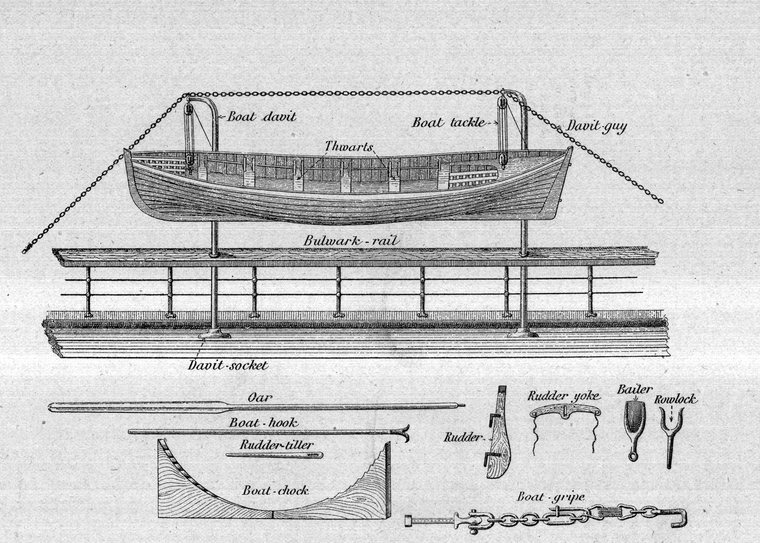
Short lengths of rope fastened to the yoke, and by pulling which the rudder is turned.
A general term for midshipmen, both in the navy and merchant service.
A small sampan of China.
A Spanish row-boat.
Borne up by, or floating in, the water.
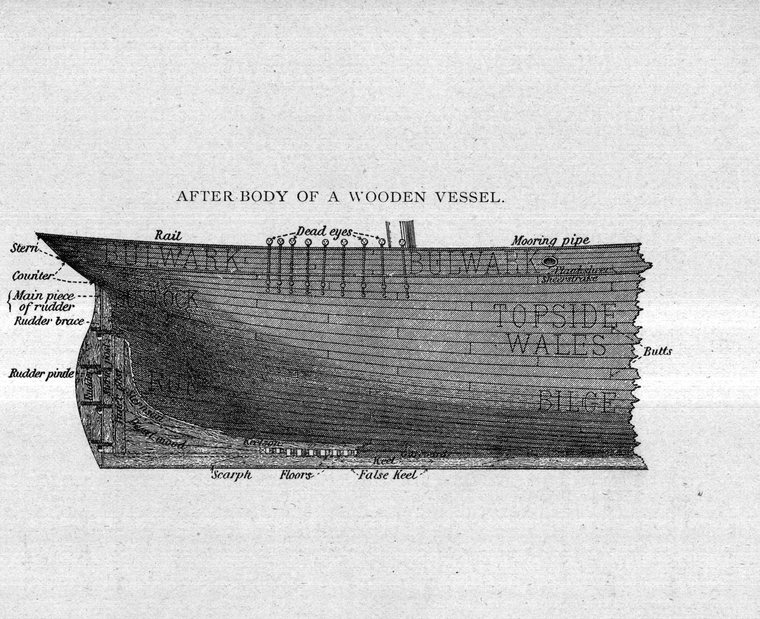
That part of a ship's body abaft the midships or dead-flat. This term is more particularly used in expressing the figure or shape of that part of the ship.
The aftermost plank in a streak.
The overhang of the stern.
All those timbers abaft the midships or dead-flat.
A cavity framed between the sides of some timbers to admit fresh air into the ship and convey the foul air out of it.