Horizon GlassNavigation
The small half-silvered and half-clear glass on the quadrant, octant and sextant.
Page 370 of Patterson’s Illustrated Nautical Encyclopedia · 38 entries
The small half-silvered and half-clear glass on the quadrant, octant and sextant.
(See Danger Angle.)
The change of position which a body in the horizon, as seen from the surface of the earth, would assume if it was viewed from the centre of the earth.
A region of calms on the borders of the trade winds.
Sixty minutes of time; the twenty-fourth part of a day.
The angular distance of a body east or west of the meridian; an angle at the poles included between different hour circles.
A great circle of the celestial sphere passing through the two poles; it marks out all places having the same hour angle.
(See Middle Point.)
The central calm space around which the winds resolve. (See Bearing of Storm Centre.)
Charts which show sections of the navigable waters of the earth, and which describe the rocks, shoals, tides, currents, soundings, etc., to be met with in navigation, suggestions for making passages, etc.
Description of the navigable waters of the earth, rocks, shoals, tides, currents, soundings, etc.
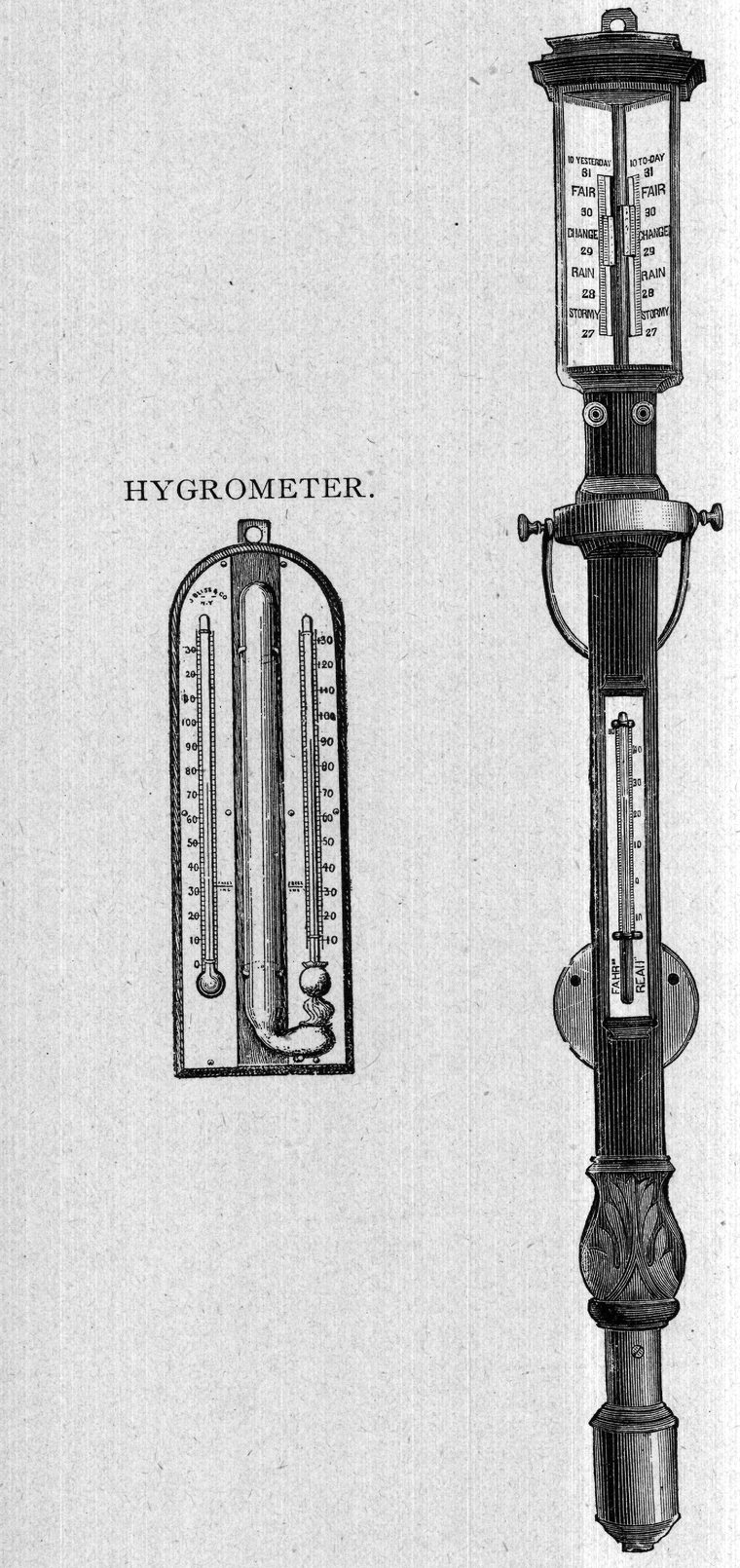
An instrument employed for measuring the amount of moisture in the atmosphere. Also known as a wet bulb thermometer.,
The longest side of a right-angled triangle.
(See Part I.)
When light is reflected from a surface, as in the artificial horizon, the angle of incidence is equal to the angle of reflection. (See engraving.)
(See Earth's Inclination.)
A name given to the flat bar on a navigating instrument of reflection which has the mirror on one end and the vernier on the other. Also known as sliding limb. Index is also the integer part of a logarithm.
The adjustment of the index glass of the quadrant, octant or sextant, which consists of making the index glass perpendicular to the plane of the arc.
When the horizon glass and index glass are parallel to one another, zero on the vernier should cut zero on the arc. If this is not effected, then a correction (index error) is to be applied to the reading of the altitude as follows: If o on the vernier is to the right hand of o on the arc, the correction will be additive, but if to the left hand it will be subtracted.
The mirror at the top of the index or sliding limb which reflects the image of the sun to the horizon glass.
The slight error due to the expansion and contraction of the sextant frame from changes of temperature enters into the consideration of equal altitudes, but in practical work the difference is not sensible.
(See Planet.)
The North-east, South-east, South-west and North-west points of the compass.
Finding the value of an element falling between two given values, as the reduction of the sun's declination for any hour previous to or after noon.
The error of an angle measured on a quadrant, octant or sextant, due to the horizon glass not being on the same plane with the index glass. This error is only perceptible when the object observed is near to, as when attempting to adjust the instrument by an object a short distance removed.
Iron-bound Coast. Shores composed of perpendicular rocks.
(See Day.)
A transit of Mercury or Venus across the sun's disc.
Illumination; apparent enlargement of the diameter of heavenly bodies. This seldom exceeds 5 sec. in the case of the sun, so that for all practical purposes irradiation is never considered.
Lines of equal barometric pressure in the regions chartered.
Equality of time, as in the vibration of the pendulum.
An equal time keeper; a clock designed to keep perfectly equal time.
Also known as Cross Staff. An old reflecting or mathematical instrument used for taking altitudes.
The log-book is sometimes termed a sea-journal.
A reform of the calendar was introduced in Rome by Julius Caesar, and adopted and used by all Christian countries until 1582, when it was reformed by Pope Gregory XIII.
The date of the commencement of the Julian calendar, January 1st, 46 years B. C.
A cycle of 7,980 years, dating from 4713 B. C.
The year, equal to 365 1/4 days, adopted in the Julian calendar.
This eminent astronomer, born in Wurtemberg in the year 1571, determined the true laws of the motions of the planets around the sun. The three laws which he discovered, are:
First. The orbit of each planet is an ellipse having the sun in one focus.
Second. As the planet moves around the sun its radius-vector, or line joining it to the sun, passes over equal areas in equal times.
Third. The square of the time of revolution of each planet is proportional to the cube of its mean distance from the sun.