Shoe BlockSea Terms
A block having two sheaves revolving at right angles to one another--one horizontal, the other perpendicular.
Page 228 of Patterson’s Illustrated Nautical Encyclopedia · 35 entries
A block having two sheaves revolving at right angles to one another--one horizontal, the other perpendicular.
A vessel shoots ahead of another when she passes her. To shoot the sun is to observe an angle of that luminary with the sextant, quadrant or octant.
To advance. (See Head Reach.)
A jocose remark in relation to measuring the sun's altitude with a quadrant or sextant.
A prop for supporting anything. To shore is to prop up. (See Dog Shores.)
A short length made on one tack.
A confused sea.
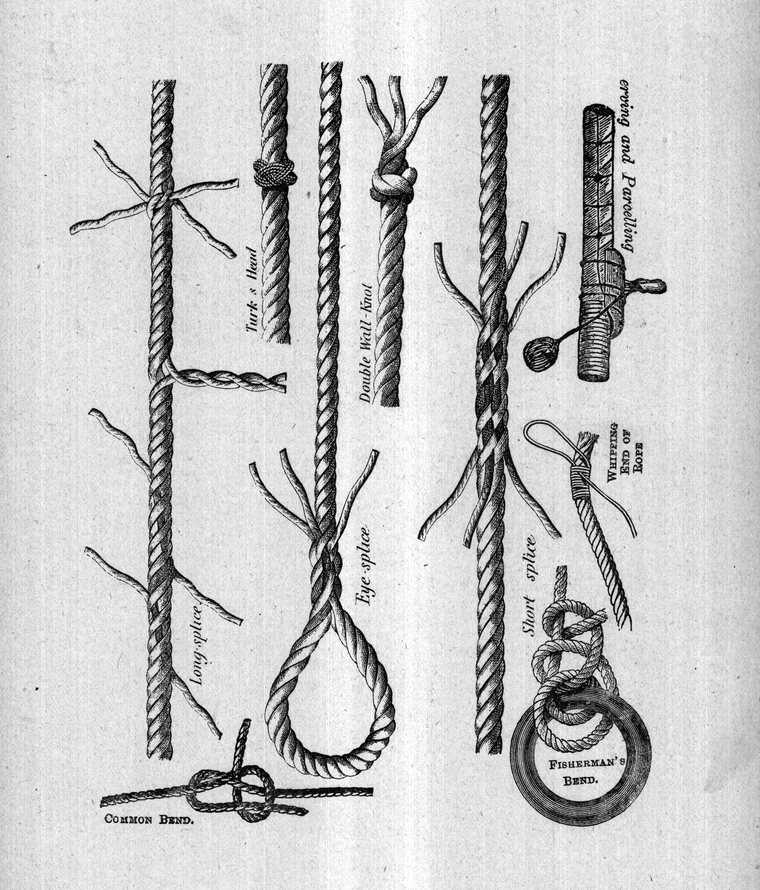
A certain kind of splice put in a rope that does not require to render through a block, as this splice, unlike the long splice, makes a bunch where the ropes are joined. It requires less length to make than the long splice, which is sometimes an important consideration.
(See Peak.)
To reef or furl some of the canvas.
The line shot over a vessel from the mortar by a life-saving crew.
The projecting part of a vessel about the water line. Fore Shoulders. That portion of the shoulder just under the bows.
A block having a projection on one end so as to keep it in place.
A triangular boat sail.
A ducking punt.
An order given to the man in the bows of a boat to shove the same clear of the ship's side so that the crew may drop their oars into the water.
An order to the crew to hurry.
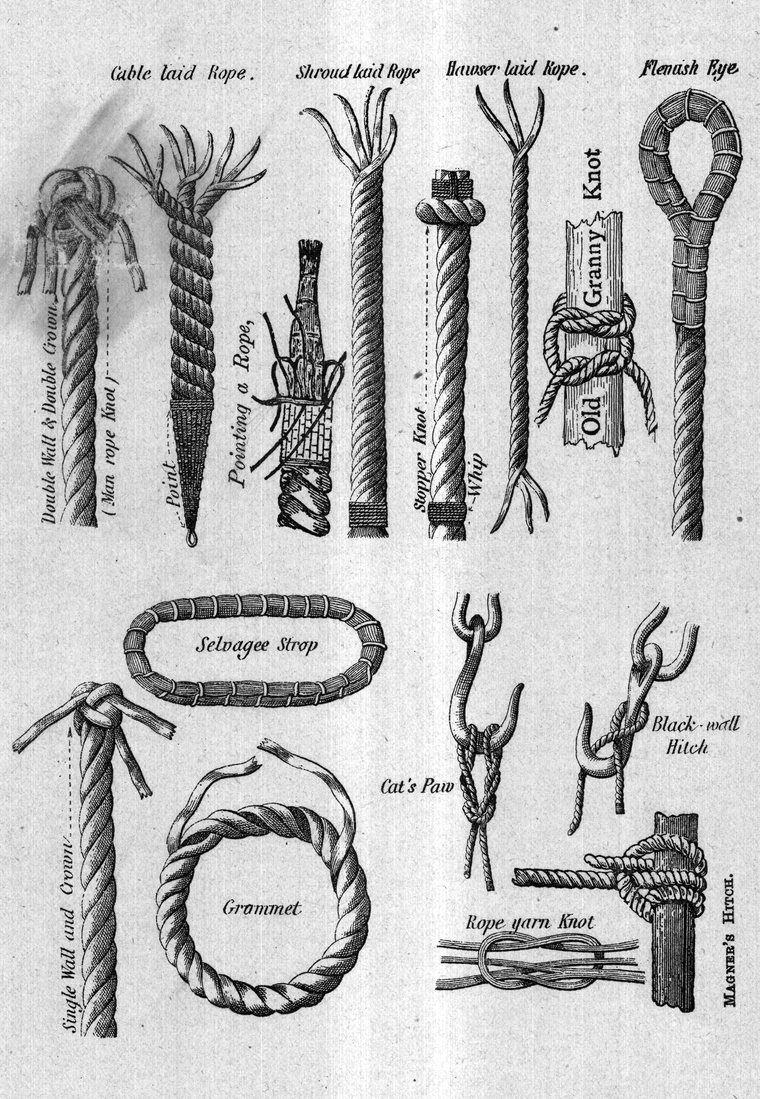
A knot put in a shroud to rejoin it after parting. (See engraving.)
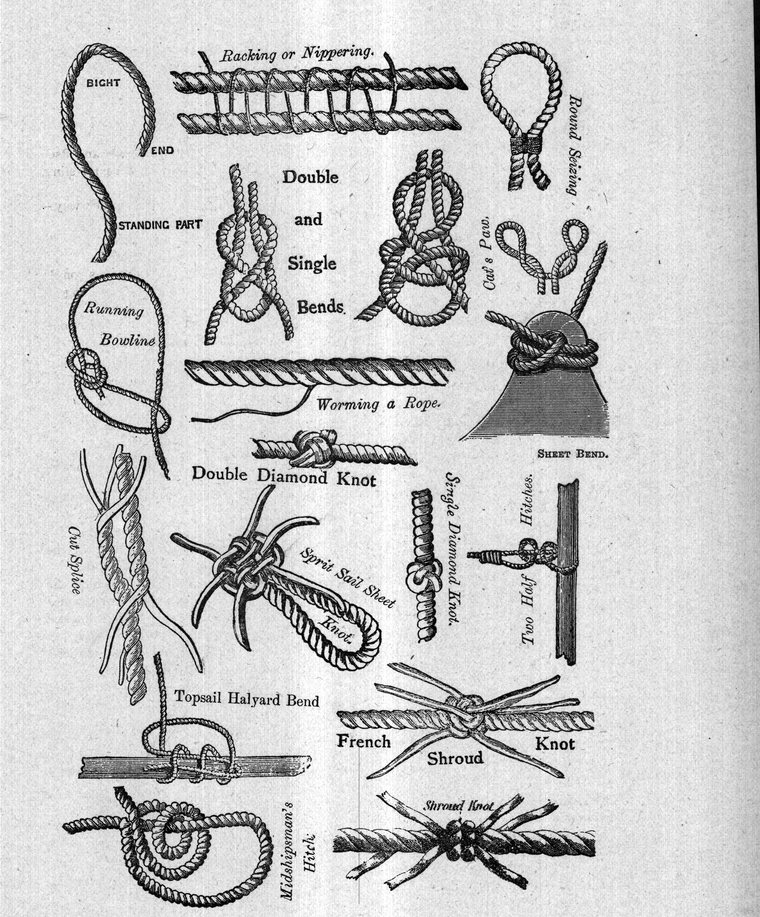
A four-strand rope laid up right-handed.
(See Chain Plates.)
Ropes of hemp or wire fitted over the mastheads and extending to the vessel's sides or to the rim of the tops, where they are set up by dead-eyes to support the masts sideways.
A compartment on board ship used as a hospital for sick members of the crew.
The outer part of the hull from the water line to the covering board.
The canvas extending from the ridge ropes to the rail.
Same as accommodation ladder.
Same as bow lighthouses.
(See Side Light Castles.)
The red and green lights carried by vessels when under way at night. The green light is carried on the starboard side, and the red light on the port side, and they show respectively over ten points of the compass, namely, from right ahead to two points abaft the beam, and are of such a character as to be visible at least two miles.
Cleats of wood or iron on the sides of a vessel, used in conjunction with man ropes for ascending and descending the vessel's side.
The tackles on the sides of the broadside carriages, and by which they are run out after the guns are loaded. (See Train Tackle.)
The halliards reeving through a dasher block on the end of the after-gaff, or through the hole in the trucks, or to any other place, and which are used for hoisting signals or flags.
Certain letters awarded to documented vessels by the Bureau of Navigation, whereby the vessel may communicate her name to another vessel at sea, or to a shore station, by the employment of certain flags in the International Code, representing the signal letters.
A very convenient match, or small prismatic torch, which is manufactured in two colors--red and green--and employed principally on yachts for signaling purposes. Also known as Bengalese matches.
The following signals are treated under this head:
Cautionary, Information, Local Forecast, Storm and Wind.
Under date of Dec. 14, 1891, the following instructions relative to the display of wind signals, were issued by the Weather Bureau to take effect January 1, 1892:
I. At stations on the Atlantic, Pacific and Gulf coasts the display of the signal known as the Cautionary Signal will be discontinued. The Storm Signal will be displayed as at present, but will be a warning of an expected wind velocity intermediate between the present cautionary and storm justifying velocities.
II. At all wind signal stations the red pennant will be used for the Information Signal instead of the yellow pennant, and at stations where Cautionary Signals are displayed, a red flag with a white center will be used for the Cautionary Signal instead of the yellow flag with a white center. This change is made to avoid confusion with the recognized quarantine signal.
III. Observers receiving notification of the hoisting of cautionary or storm signals at stations other than their own will, unless their own signals are flying, display "Information Signals." These signals may be lowered at the discretion of the observer.
IV. Observers in charge of stations on the Great Lakes, Atlantic, or Gulf coasts, whenever, except between the hours of 8 to 11, a. m. and p. m., the local conditions, in their judgment, indicate the occurrence in their vicinity within eight to twelve hours of winds of a verifying velocity (no signal being displayed at their station), are authorized to advise this office by telegraph of that fact by sending a message giving briefly their reasons or the data called for in a special observation and ending with the word "signals."
Local forecast officials, and observers specially authorized, at stations in the aforementioned regions, whenever between 5 p. m. and 10 p. m. and midnight and 10 a. m. the conditions in their judgment very strongly indicate the occurrence within four to six hours of winds of a verifying velocity, are authorized to hoist signals, notifying this office immediately by telegraph of their action. These messages will give the kind of signal and time of hoisting, and, if necessary, reasons in brief for such action. They may also within these hours change the direction of, continue or lower signals when in their judgment the conditions strongly indicate such action, reporting the fact immediately by telegraph to this office.
The same rules as to the length of the display will apply to these signals as to those ordered by the official at this office.
Local forecast officials and observers will exercise the greatest caution in displaying signals under this authority, remembering that it is given them not that they may use it regardless of the judgment of the forecast official at this office, but rather that they may give warning of the approach of storms whose rapidity of progress or development is much greater than is indicated by regular observation.
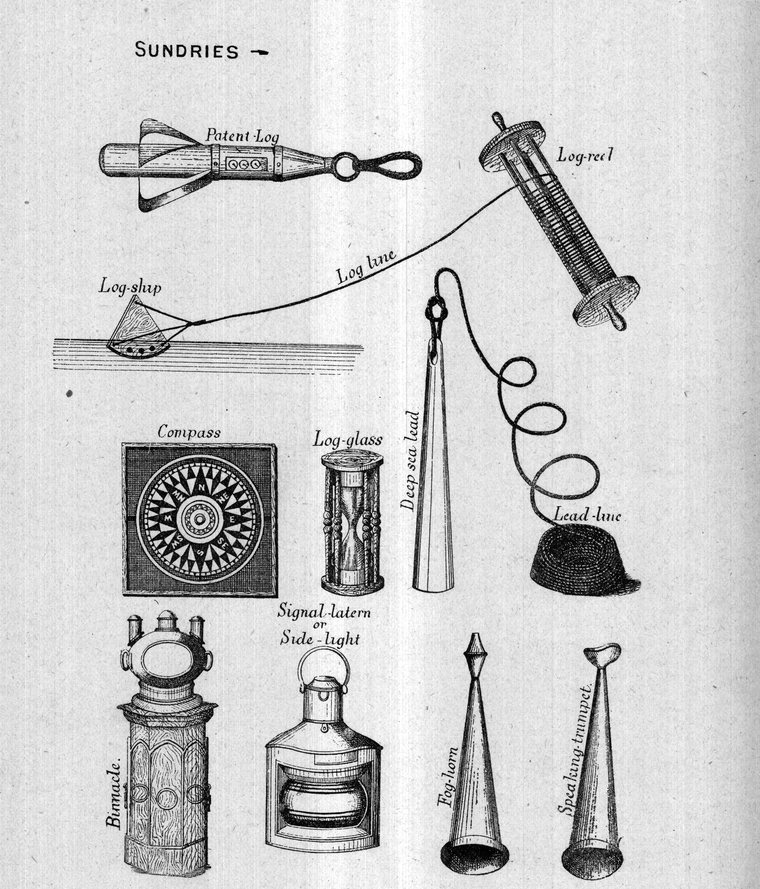
(See Coston, Distance, International, Semaphore, Weather and Wig Wag Signals--see also engraving.)
Mud; sediment.