HoundsSea Terms
Projections bolted on to the masthead which serve as shoulders for the trestle-trees, and which in turn support the top.
Page 144 of Patterson’s Illustrated Nautical Encyclopedia · 43 entries
Projections bolted on to the masthead which serve as shoulders for the trestle-trees, and which in turn support the top.
To house a mast is to lower it partly and secure its heel by a lashing to the mast against which it is lowered.
A broad, shallow draught vessel with a house extending over nearly its entire length, fitted up with large, airy living rooms. Some of these boats are towed around from harbor to harbor, and others are provided with their own motive power--either sails or steam.
House-Line (pronounced house-lin). A seizing stuff made of three small yarns and laid up left-handed.
Houses built along dangerous and non-inhabited coasts, and supplied with boats and provisions for the use of shipwrecked seamen who may have been cast ashore in their vicinity.
The housing of a mast is all that is below the spar or upper deck; the housing of a bowsprit is that part from the stem inboard.
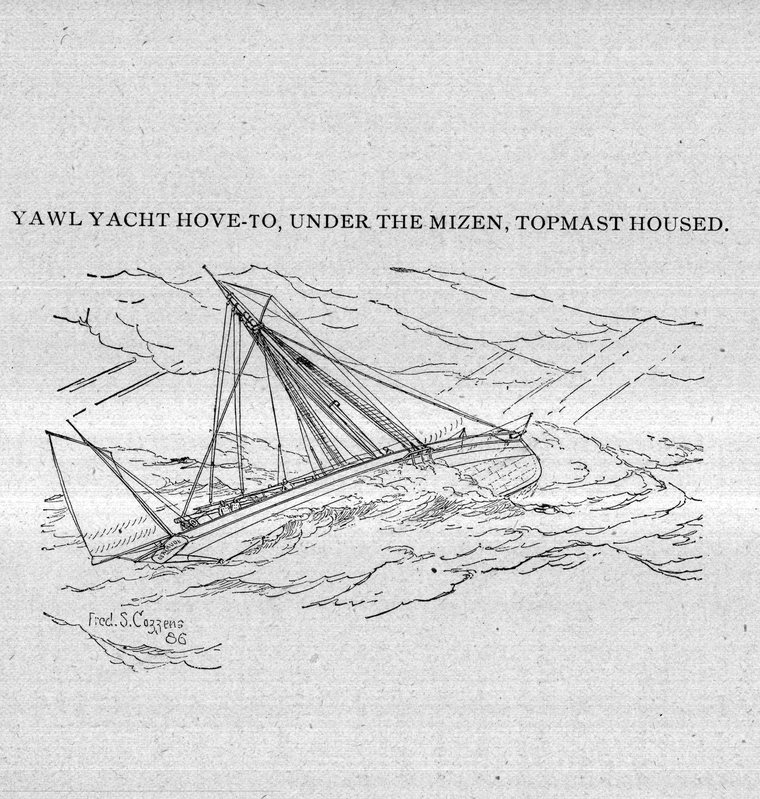
(See Heave Short.)
(See Lie-to.)
To hug the land is to keep close to it in sailing. To hug the wind is to keep the vessel by the wind.
A vessel unfit for use at sea. (See Sheer Hulk).
The body of a vessel exclusive of masts, spars and rigging.
When only the spars of a vessel are visible above the horizon.
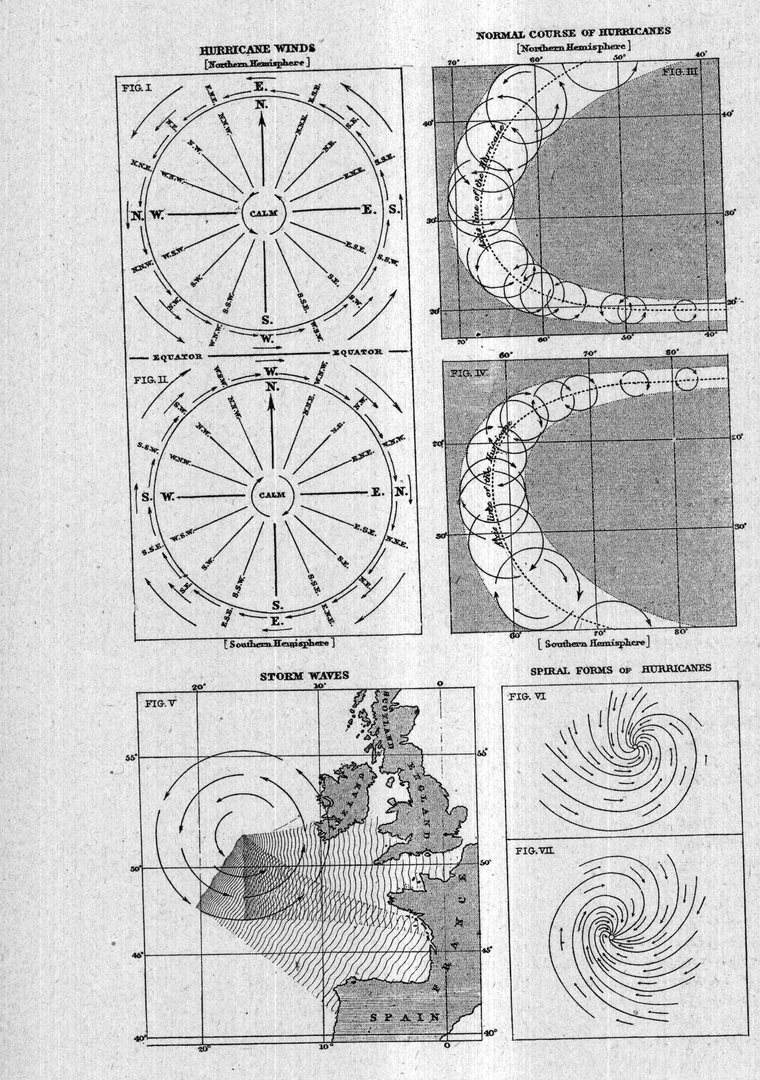
A revolving wind storm of great violence, extending over an area from a few to hundreds of miles.
(See Deck.)
(See Dock.)
(See Nautical Surveying.)
Water solidifies by cold at 32 deg. F. Salt-water ice in salt water floats with only one-ninth of its mass above water, and fresh-water ice in salt water floats with one-eighth of its mass above water. A wide expanse of ice is called a field, and one of smaller dimensions a floe; when a field is dissevered and broken into numerous pieces it is termed a pack; this, again, when of a broad shape is called a patch, and when much elongated a stream. When it is possible for a ship to sail freely through floating ice, the same is termed drift ice, and the ice itself is said to be loose or open. When the ice is crushed into fragments it is known by the name of brash ice. A portion of ice rising above the common level is called a hummock. The term sludge applies to the soft crystals which the frost forms when it first attacks the ruffled surface of the ocean, and when this sludge separates into small patches by the agitation of the water these patches are called pan cakes.
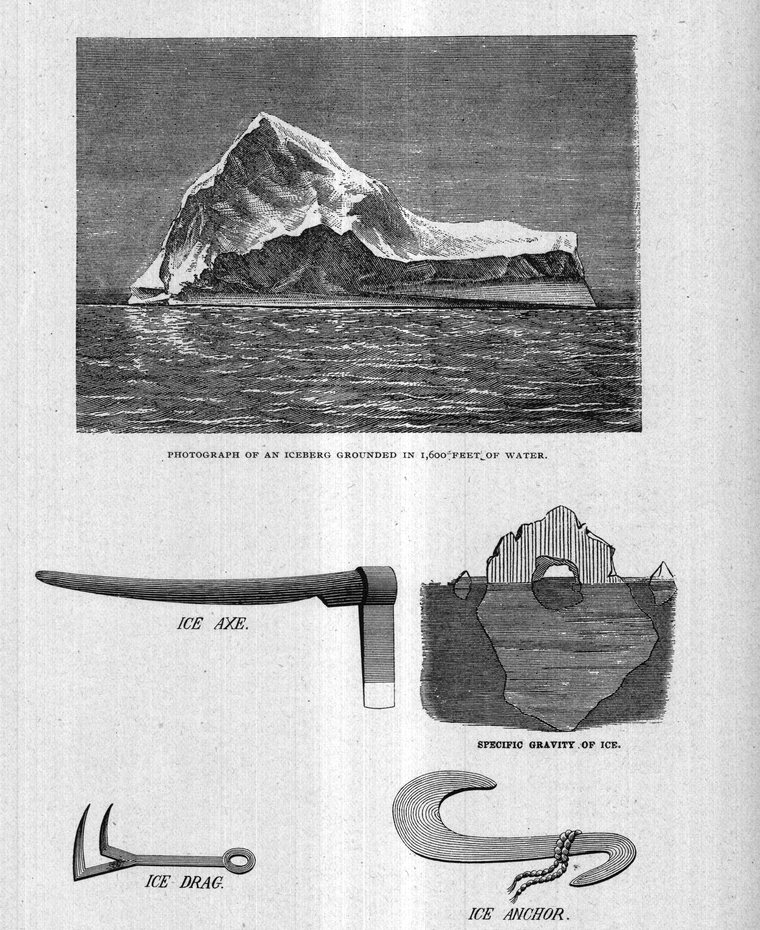
A peculiar iron shape used for anchoring a vessel to the ice.
As its name implies, an axe used for chopping ice. It has an extremely long head. (See engraving.)
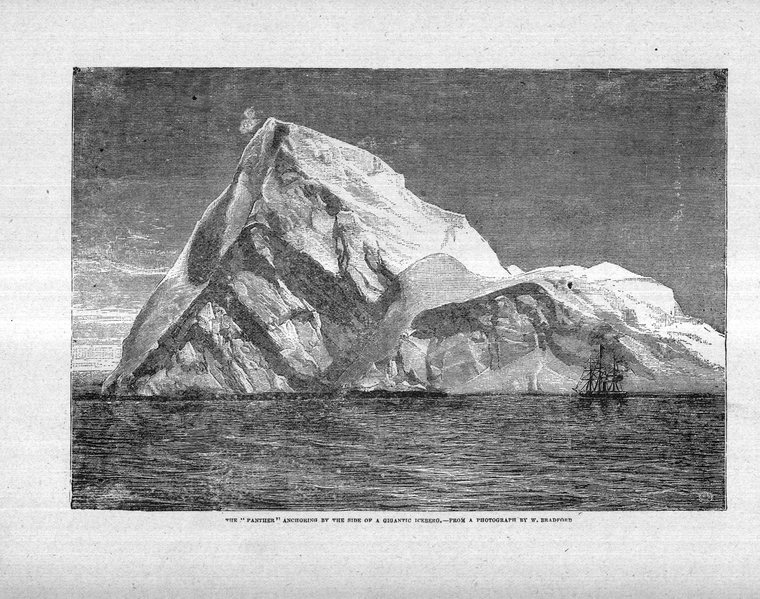
A floating ice mass of great magnitude being detached from glaciers on the shores of the polar seas. Icebergs have been seen which were five miles in length and 300 feet in height from the water-line. (See engraving.)
A fore-and-aft sail is supported by beams resting on iron-shod runners, which are connected like the hulls of a catamaran. These boats are capable of great speed, at times shooting along under such tremendous headway as to outstrip for a brief interval the wind itself.
Being prevented from sailing by being surrounded by ice.
A shimmering whiteness about the horizon caused by the reflection of light from a field of ice.
A basin, either natural or sawed out with ice-saws, sufficiently large to haul the ship into. This is often done by navigators in the polar regions in order to avoid being nipped between two closing floes.
An iron instrument used for planting in the ice ahead of the vessel and warping her along. (See engraving.)
(See Ice Lead.)
A temporary channel of water leading into or through an ice field, but which is liable to close at any moment with the motion of the ice acting under the influence of the tides and winds.
A person employed on board of vessels navigating the polar seas whose duty it is to give counsel to the captain in regard to ice navigation.
The meeting of two floating bodies of ice. When a vessel is caught between two such bodies she is said to be nipped.
A large steel saw used for cutting a channel through ice, varying in length from 10 to 25 feet.
(See Ice Lead.)
A line supposed to exist between the race committee's boat and the flag boat or other object, and across which the vessels must go after the firing of the starting gun.
To seize for public use; to use compulsion in getting crews for public vessels; to force seamen on board a vessel of war against their wish to serve on board such vessels. (See Press Gang.)
On board.
The order to get on board all the boats not carried at the davits. Up boats is the order to hoist the boats to the davits.
The order given to the bow oarsmen of a single-banked boat, or the two bow oarsmen of a double-banked boat, signifying that he or they are to cease rowing and ship the oar or oars, standing ready with the boat-hook to catch hold of the dock or vessel's side, as the case may be.
The order to clew up a square sail or to drop the peak and throat of a fore-and-aft sail.
The situation of a vessel after her helm has been put down and she has come up into the wind preparatory to going about on the other tack.
When a ship is so close to the wind that all her sails are shivering.
Within the hull.
A name given to the large sailing ships once belonging to the East India Company, but now a general title for all vessels engaged regularly in trade with the East Indies.
A strong current setting through a strait, such as the Straits of Gibraltar, which connects the Atlantic Ocean with the Mediterranean Sea.
(See Signals.)
Rivers, harbors, bays, gulfs, seas, lakes and sounds.