GunneryNaval
The science of managing ordnance.
Page 476 of Patterson’s Illustrated Nautical Encyclopedia · 48 entries
The science of managing ordnance.
A training ship for officers undergoing ordnance instruction.
(See Powder.)
The distance that a projectile is thrown by a gun.
The various responses made by officers at night to the sentry, and by which he may learn the rank of the officer approaching, are as follows: The flag officer answers "Flag!"; the captain gives the name of his ship; the wardroom officers answer, "Aye! aye!"; the steerage and warrant officers answer, "No! No!"; and a petty officer and members of the crew answer "Hello!"
A charge of small cannon-shot fired for cutting purposes.
Ports made in two pieces and hinged top and bottom, so as to open by tricing up the upper one and dropping the lower one. A circular hole is provided in the centre of the shutter so that a length of the gun may project outboard.
A shell filled with an explosive, and thrown by hand from the tops to the enemy's deck when vessels are fighting at close quarters. It is also used to repel boat attacks.
A wooden lever.
When slow ignition occurs a piece is said to hang fire.
The sanitary compartment set aside for the use of the crew.
Used for extracting cartridges from small-arm rifles.
(See Hail.)
Dynamite, gun cotton, nitro-glycerine, fulminates, picrates, Emmensite, and glycerine.
These guns are divided into two classes, and are known as rapid-fire (R. F.) and machine (M.) and throw I-lb, 3-lb. and 6-lb. explosive projectiles respectively. The Hotchkiss machine-gun is on the principle of the Gatling--a revolving cannon, has five barrels, and throws I-lb. and 3-lb. projectiles. The greatest range of the 3-lb. machine-gun is about 1 1/2 miles at an elevation of, say, 30 deg., and the range of the I-pounder is about I mile for the same elevation. There are also I, 3 and 6-pounder Hotchkiss rapid-fire guns, which are loaded at the breech and throw single projectiles, the ranges of the I and 3-pounders being respectively 2 miles and 1 1/2 miles, and the penetration about 1 1/2 inches and I inch of steel at 1,000 yards. The range of the 6-pounder is about 3 miles with an elevation of 30 deg., and its penetration is about 2 inches of steel at 1,000 yards. The Hotchkiss machine-guns may be fired at the rate of fifty projectiles per minute, the rapid-fire guns at the rate of twelve per minute. The cartridges used in these machine-guns have metallic cases, on the principle of the revolver cartridge, and they are fired by a revolving crank. The rapid-fire guns are fired by a trigger, as in a small arm.
The bolt that locks the carriage in the desired position.
(See Torpedo.)
A small cannon used principally in field operations. Previous to the advent of rapid-fire guns it was carried in the bows of boats on a flat carriage.
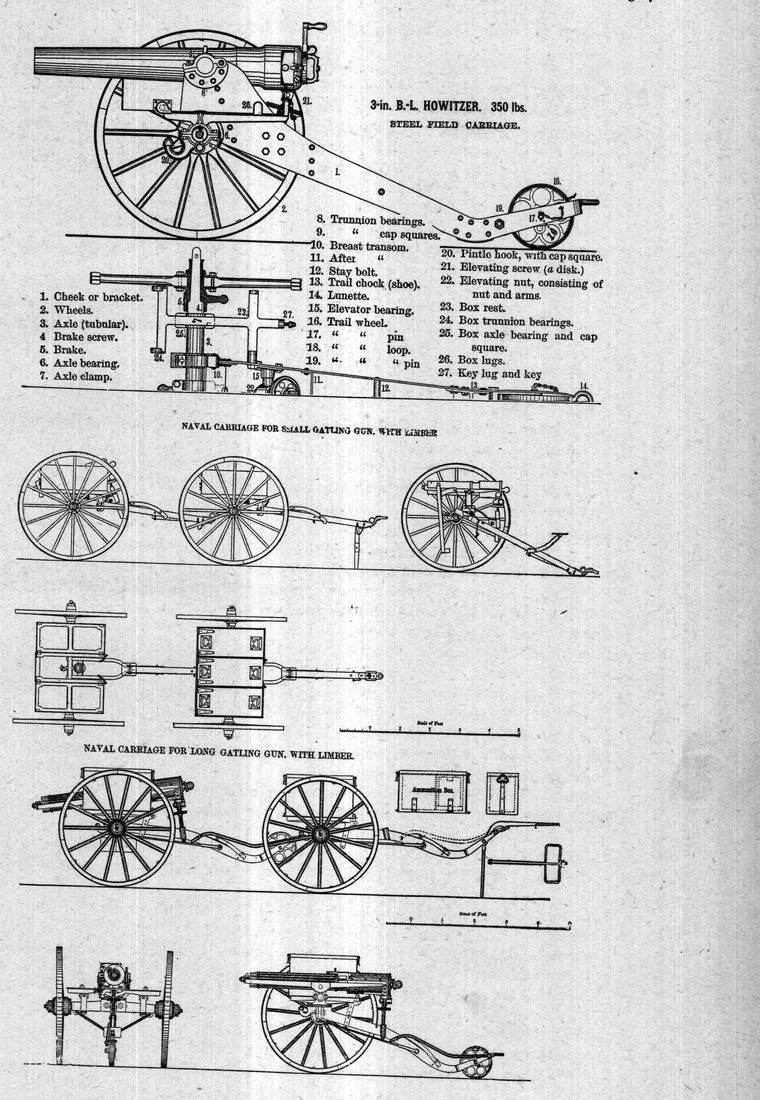
A carriage provided with one or more cylinders filled with liquid (glycerine and water) and with pistons attached to the carriage and slide to take up the recoil of the gun.
Those members of the ship's company who do not stand watch, such as the cooks, stewards, yeomen, musicians, writers and apothecary.
A shell charged with an inflammable substance, which escapes when the shell is broken by coming in contact with another body.
(See Uniform.)
(See Armor.)
A term applied to monitors during the war of the Rebellion. The qualification is applicable to all vessels that are protected with armor against projectiles. (See Monitor.)
One of the crew, who acts as an assistant to the pay-master's yeoman.
A nickname for the master-at-arms.
A rate signifying that the person has no knowledge, or very little knowledge, of seamanship. It is a rate next below that of ordinary seaman.
A commission granted by government to a privateering vessel.
The grade next below that of lieutenant-commander, and next above that of lieutenant, junior grade. Lieutenants, junior grade, were at one time called masters. A lieutenant of marines ranks the same as an army lieutenant. (See Relative Rank.)
A line officer one grade lower than a commander, and one grade higher than a lieutenant.
A line officer one rank under a lieutenant, and one rank higher than an ensign.
An obsolete type of man-o'-war, having three rows of ports and carrying from 74 to 120 guns.
Admiral, vice-admiral, rear admiral, commodore, captain, commander, lieutenant-commander, lieutenant, lieutenant junior grade, ensign, midshipman, cadet-midshipman, mate, boatswain and gunner.
A loaded primer--one that has not been used.
A fuzed shell charged with powder.
A metal shelf for assisting the passage of a shell into the breech.
The lanyard used to fire the primer which explodes the charge in the gun.
A gun of great length and range as compared with the broadside gun.
(See Hotchkiss, Gatling.)
A petty officer of the first class, who stands watch in the engine-room when the vessel is under way; belongs to the artificer class.
An apartment on board a man-o'-war in which explosives are stored. Also a chamber in a repeating rifle for containing a number of cartridges with which the gun is fed automatically.
A faucet contrivance connected with the outside of the vessel for flooding the magazine in case of fire.
A worsted frock and shoes of canvas-metal of whatever nature being absent.
A repeating rifle. The magazine is detachable in the rifle used in the U.S. Navy, and the detaching of the same converts the rifle into a single-fire arm.
An alleyway in the magazine.
A screen of thick cloth arranged so as to prevent sparks from entering the scuttle in the magazine passage.
The scuttleway in the magazine passage through which the charges are passed.
The duty of the marine corps is to furnish a guard to ships of war and to garrison navy yards. Commissioned officers of the marine corps are: colonel-commandant, colonel, lieutenant-colonel, major, captain, first lieutenant and second lieutenant. The non-commissioned officers are: sergeant-major, quartermaster-sergeant, drum-major, first sergeant, sergeant and corporal.