PitchingSea Terms
The fore-and-aft motion of a vessel in a seaway; for a ship to bury her head in the seas.
Page 196 of Patterson’s Illustrated Nautical Encyclopedia · 26 entries
The fore-and-aft motion of a vessel in a seaway; for a ship to bury her head in the seas.
The ports specified in a charter party at which the vessel is to touch.
The regular working sails of a vessel and not such as are set flying like stun' sails, balloon sails, etc.
Horizontal timbers laid fore-and-aft over the tops of the frame timbers which are even with the deck. Also called covering boards.
(See Planks.)
Broad timbers of oak, pine, etc., from 1 1/2 to 8 inches thick, and used for planking a vessel's sides and covering the deck beams.
To braid small stuff or rope is to plat it.
(See Chain Plates.)
A certain freedom of movement. A rudder plays in the rudder-port when the port is so large as to have considerable space between it and the rudder-head.
A wedge of wood which fits into the plug-hole in the bottom of a boat. The plug is withdrawn when the boat is hoisted, so as to allow the water in the bottom to escape.
(See Duff.)
(See Ship Plumbing.)
A vessel is said to ply when she is working to windward.
A painted circle containing a horizontal line through the center. This figure is to be found on the sides of all English merchant ships, and marks the extreme limit of loading. The name of the mark is derived from its author.
To taper the end of a rope. (See engraving.) One of the 32 divisions on the mariner's compass.
The natural line of sight; the direction of a gun when leveled horizontally.
(See Out Point.)
The admiralty chart of the Arctic regions, contained in Part I. of this volume, records the names and dates of the various polar expeditions from 1818 to 1874. Since the latter date several exploring parties have sailed north, namely, the English Expedition of 1875, the Nordenskjold Expedition of 1875, the Jeanette Expedition of 1879, and the Greeley Expedition of 1881. Lieutenant Lockwood, U. S. A., second in command of the Greeley Expedition, sledged to the highest latitude ever reached by man--83 deg. 24 min. north. 396 miles from the pole; consequently, in this year, 1891, the United States is awarded the honor of first rank in polar explorations.
That part of the highest mast which is above the shoulder on which rests the eyes of the rigging. A topgallant mast has a royal pole and a royal mast has a skysail pole.
A lowermast and topmast in one piece.
A vessel peculiar to the Mediterranean. It is square-rigged, but has neither tops nor cross-trees, and the masts are single spars, running without a break from their step to the trucks.
(See Deck.)
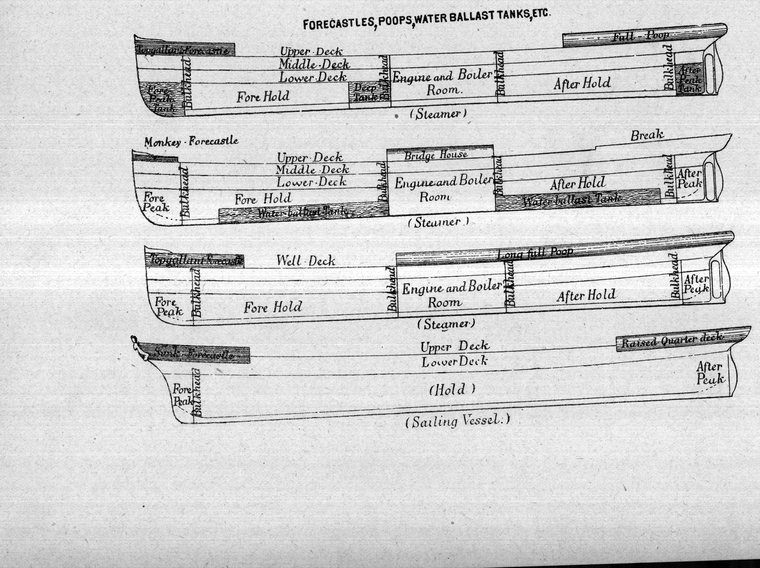
A vessel is pooped when a sea breaks over her stern.
When a vessel is scudding, and a sea follows so fast after the vessel as to fall on her poop or on the after part of the ship, it is said to be a pooping sea.
A name sometimes applied to the small pins set into the gunwale of a boat, between two of which the loom of the oar works. Also upright pieces of timber between the vessel's bottom and the bilge ways at the forward and afterends, and which support her in launching.
The left-hand side of the vessel looking forward; at one time called larboard.