GlutSea Terms
A piece of canvas having an eyelet hole worked in it and sewed into the middle of a square sail near the head. A becket is made through this hole and the bunt jigger is hooked into it.
Page 126 of Patterson’s Illustrated Nautical Encyclopedia · 26 entries
A piece of canvas having an eyelet hole worked in it and sewed into the middle of a square sail near the head. A becket is made through this hole and the bunt jigger is hooked into it.
A vessel goes about when she tacks.
Another name for the martingale back-rope.
A vessel goes free when she has a fair wind.
A vessel goes large when the wind is abaft the beam.
A seaman's best suit of clothes.
A rowing barge used on the canals of Venice.
Keeping the sails a little more full than in full-and-by.
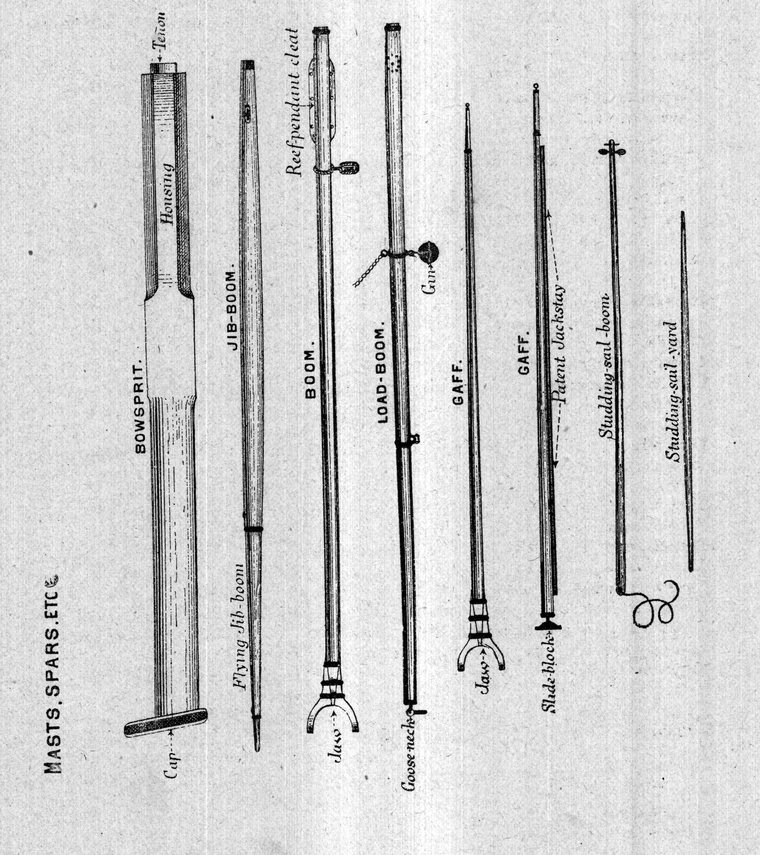
A king of hook made of iron and fastened to the inner end of a boom having no jaws, also to the inner or lower end of a spinnaker-boom. The goose neck confines the end of the boom by being secured to an iron clamp or eye on the mast. Independent steps for spinnaker-boom goose necks are found on yachts, the steps being fastened to the deck.
When the clew of a course or topsail is hauled up and lashed to its yard the sail is said to be goose-winged. (See Wing and Wing.)
Angles cut slopewise at one or both ends of cloths in sailmaking, so as to widen or increase the depth of a sail.
Pieces of canvas cut on the bias and added to the sail.
A coasting vessel of India.
A weaving of fish line around a ring or the strop of a block. In the latter case it takes the place of parceling and service.
The name given to a four-oar boat once the property of Peter the Great. It is preserved at St. Petersburg, Russia, and known as the origin of the navy of that country.
A capsized reef or flat knot. A knot apt to be made by a novice in seamanship. (See engraving.)
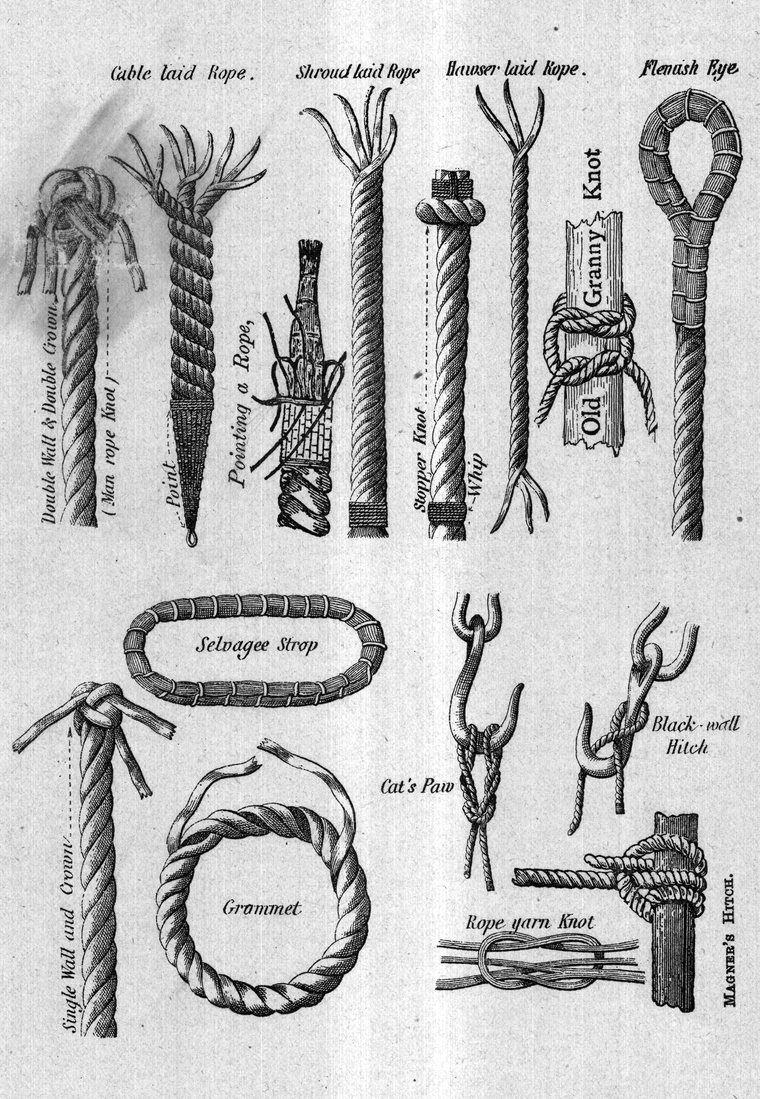
A slippery hitch.
1. Foretopmast or Jib Topsail Stay.
2. Flying Jibstay.
3. Jibstay.
4. Forestay.
5. Flying Jib.
6. Jib.
7. Forestaysail.
8. Fore Gaff Topsail.
9. Foresail.
10. Maintopmaster Staysail.
11. Main Gaff Topsail.
12. Mainsail.
13. Jib Topsail furled on Jib Boom.
14. Jib Boom.
15. Bowsprit.
16. Martingale.
17. Fore and Main Shroudsrattleddown.
18. Bobstays, which secure the Bowsprit and prevent it from lifting.
A small anchor having four arms. (See engraving) (See Grappling Irons.)
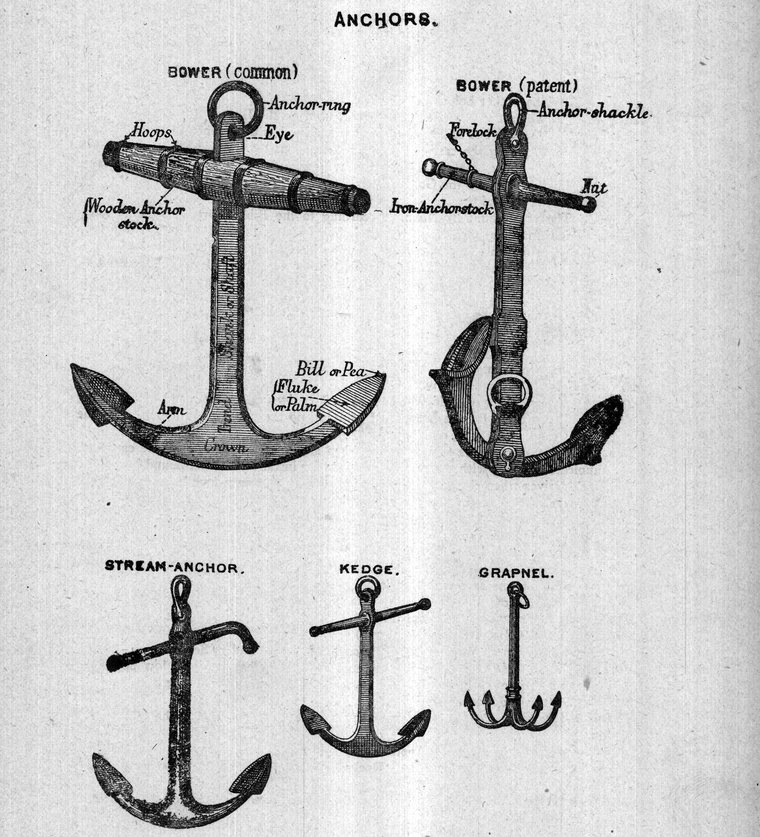
Four hooks radiating from a common shank; to the ring in the upper part of the latter a rope being made fast, and the instrument used for the purpose of fastening vessels to one another.
Lattice-work platforms used to cover hatches; to take the place of bottom boards in a boat; the grating deck which covers the helm and tackles on the after-deck of a steamer, etc.
To grave a vessel's bottom is to burn off the accumulation of marine growth.
(See Dry Dock.)
Lines trending east and west traced on charts, always concave to the equator, and which, allowing for the spherical figure of the earth, show the shortest route between two places situated to the eastward and westward of each other. (See Charts.)
The largest vessel ever built until the Celtic was constructed; designed by the great English civil engineer Isambard Kingdom Brunel, who was born in 1806 and died in 1859; built by Scott Russell at Midwall on the Thames, for the Eastern Steam Navigation Company; construction begun May 1, 1854; built broadside to the river on very flat pitch ways, necessitating the launch to be effected sideways; launching process commenced November 3, 1858, and occupied three months, hydraulic power being employed; iron used in construction of hull; length, 680 feet; beam, exclusive of paddle-boxes, 82 1/2 feet; inclusive of same, 118 feet; height of side to bulwark rail, 70 feet; freeboard from water line to covering board or plankshear, 37 feet; draught, 27 feet; tonnage, 20,000; eight engines; aggregate horse-power, 11,000; both screw propeller and paddle-wheels; steam pressure, 25 pounds; revolutions of screw 55 per minute; revolutions of paddle-wheels, 12 per minute; ten anchors; one mile of chain cable; six iron masts, the forward one a pole mast, on which was set a fore-staysail and a gaff foresail; second and third masts square rigged; fourth, fifth, and sixth masts were pole masts like the first and carried gaff sails; masts were named respectively as follows, beginning with the forward one: fore-staysail mast, fore-mast, main-mast, mizzen-mast, jigger-mast, and spanker mast; iron masts and yards: 7,000 yards of canvas in the sails; two large steam launches; twenty large row-boats; double bottom; five smoke pipes; wire standing rigging. The Great Eastern visited New York in 1860, and again in 1867, the latter time carrying passengers and freight from Havre, France. She was ever a financial failure, and was sold in 1864 by her original owners for pound 25,000. In 1888 she was sold as junk and broken up for her iron.
A violent gale.
(See Grave.)